English | 中文





Authors:
Xiangcheng HU,
Jin Wu and
Xieyuanli Chen
Contact: [email protected]
Offline manual loop-closure editing and optimization tools for LiDAR mapping pose graphs.
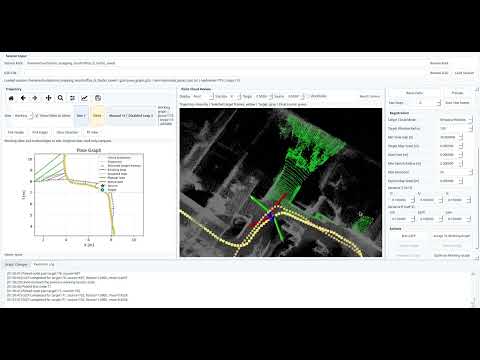
Watch the Tutorial
Overview
This repository packages the manual loop-closure workflow into a standalone project with:
- a PyQt GUI for trajectory inspection and point-cloud-assisted loop editing
- a Python-first offline optimizer backend for exporting new pose graphs and maps
- helper scripts for virtual environments, Python GTSAM checks, legacy backend build, environment checks, and screenshot generation
It is designed for mapping results that already contain:
pose_graph.g2ooptimized_poses_tum.txtkey_point_frame/*.pcd
Screenshot

Workflow

The GUI lets you inspect trajectories, select node pairs or existing loop edges, preview target/source point clouds, run GICP, add or replace loop constraints, manage a working graph session, and export a new optimized map.
Feature Demos
Add Loop

Add a new manual loop after validating a GICP result.
Replace Loop

Replace an existing loop edge with a better manual registration result.
Disable Loop

Temporarily disable an existing loop edge before re-optimization.
Key Features
| Feature |
Description |
| Embedded PyQt + Open3D viewer |
Inspect trajectories and point clouds in one workflow |
Working / Original trajectory comparison |
Compare the edited graph against the baseline graph |
| Manual edge add, replace, disable, restore |
Control loop constraints explicitly in a working session |
| Interactive source alignment in point-cloud view |
Refine source initialization before GICP |
| Auto yaw sweep for ground robots |
Search yaw seeds before final registration |
Offline export of g2o, TUM, map, and trajectory PCD |
Produce clean optimized outputs after validation |
| Session-based graph editing with undo and change tracking |
Keep a controlled workflow while revising loop edges |
Quick Start
Fastest path: Docker
cd ~/my_git/Mannual-Loop-Closure-Tools
make docker-build
xhost +local:docker
docker run --rm -it \
  --net=host \
  -e DISPLAY=$DISPLAY \
  -e QT_X11_NO_MITSHM=1 \
  -v /tmp/.X11-unix:/tmp/.X11-unix:rw \
  -v /path/to/mapping_session:/data/session \
  manual-loop-closure-tools:latest \
  python launch_gui.py --session-root /data/session
Docker FAQ for first-time users:
- Need a display permission first:
xhost +local:docker
- Mount your host session to
/data/session
- Host outputs stay under
manual_loop_projects/, manual_loop_runs/, and manual_loop_exports/
- Headless usage is supported through the Python optimizer CLI
- Full details: docs/DOCKER.md
Recommended local path: requirements.txt + .venv
cd ~/my_git/Mannual-Loop-Closure-Tools
make venv
source .venv/bin/activate
make gtsam-python
python launch_gui.py --session-root /path/to/mapping_session
For normal use, you can stop here. ROS, catkin, and the legacy C++ optimizer are optional.
The Python GTSAM 4.3 wrapper now has a repository helper path:
You can also point directly to a g2o file:
python launch_gui.py --g2o /path/to/pose_graph.g2o
Alternative path: conda
cd ~/my_git/Mannual-Loop-Closure-Tools
conda env create -f environment.yml
conda activate manual-loop-closure
python launch_gui.py --session-root /path/to/mapping_session
Python-First Optimizer Path
After reviewing the pose-graph optimization path against the current C++ implementation, this repository now treats the Python backend as the normal runtime path for the validated manual loop-closure workflow.
The legacy C++ optimizer is retained only as:
- a developer fallback
- a parity reference
- a regression benchmark path
It is no longer required for normal installation or GUI usage.
If you still want the legacy backend locally:
cd ~/my_git/Mannual-Loop-Closure-Tools
make backend
By default, the GUI now exposes only the Python-first path. The legacy C++ selector stays hidden unless a developer explicitly enables it.
Key GUI Modes and Parameters
The most important runtime controls now behave as follows:
Optimize mode in Advanced
Fast ISAM2 is the default mode for interactive graph editing.Accurate LM remains available as the batch-style parity/reference solve.
TgtVoxel in Registration
- default:
0.1 m
- affects the target submap density used for preview and GICP.
MapVoxel in Advanced
- default:
0.1 m
- affects only the final exported global map rebuild during
Export.
Practical guidance:
- use
Fast ISAM2 while adding, replacing, disabling, or restoring loops repeatedly
- use
Accurate LM when you want a direct batch-solve reference before export or parity checks
- after
Add or Replace, the current GICP candidate is consumed and the button is disabled again
- if you adjust the seed, delta, or target-map settings, rerun GICP before accepting another graph change
Test Data
You can download a sample mapping session for quick validation here:
Tested Environment
The current repository content was tested with the following dependency versions on Ubuntu 20.04. Python-only usage is the primary path; the ROS/catkin backend is kept as a fallback.
| Ubuntu |
ROS |
Python |
catkin_tools |
CMake |
GCC / G++ |
| 20.04 |
Noetic (fallback) |
3.10.16 |
0.9.4 |
3.25.0 |
9.4.0 |
| Open3D |
PyQt5 |
Qt |
NumPy |
SciPy |
Matplotlib |
OpenCV |
PCL |
GeographicLib |
GTSAM |
| 0.19.0 |
5.15.10 |
5.15.2 |
1.24.4 |
1.14.1 |
3.10.8 |
4.2.0 |
1.10.0 |
1.50.1 |
4.3.0 |
Output Artifacts
The tool now separates edit history, optimization outputs, and final export manifests:
| Location |
Purpose |
Main files |
manual_loop_projects/<project_id>/ |
Persistent edit project state for resume and review |
project_state.json, execution.log, operations.jsonl |
manual_loop_runs/<run_id>/ |
One optimization run output |
edited_input_pose_graph.g2o, manual_loop_constraints.csv, pose_graph.g2o, optimized_poses_tum.txt, pose_graph.png, manual_loop_report.json, run_context.json |
manual_loop_exports/<export_id>/ |
Lightweight final-export pointer without duplicating the full run directory |
export_manifest.json, selected_run.txt, run symlink |
Resume behavior:
Load Session resumes the latest edit project for the selected session root.Resume Project restores a specific historical project by selecting its project_state.json.Optimize updates the working graph and optimized TUM immediately, but defers full map rebuilding.Export builds global_map_manual_imu.pcd and trajectory.pcd on demand before writing the final manifest.- Export no longer copies the full optimized run again; it records a manifest that points to the selected run.
Python vs C++ Parity Validation
The Python backend was validated against the legacy C++ optimizer on multiple real sessions. The GUI now defaults to Python and only falls back to C++ when Python optimization fails and a legacy binary is available.
| Session |
Constraints |
Python time [s] |
C++ time [s] |
TUM max t err [m] |
TUM max r err [rad] |
g2o max t err [m] |
g2o max r err [rad] |
Map points Py / C++ |
office_fs_fastlio_saved |
1 |
10.193 |
2.096 |
5.20e-09 |
3.11e-06 |
6.85e-05 |
3.27e-06 |
4,850,749 / 4,850,749 |
floor34-1_fs_fastlio_saved |
1 |
16.335 |
3.827 |
1.00e-09 |
3.56e-06 |
6.83e-05 |
4.50e-06 |
13,771,605 / 13,771,605 |
dr_tunnel_2026_01_24_145439 |
0 |
12.112 |
2.909 |
2.49e-08 |
2.87e-09 |
4.99e-04 |
1.05e-06 |
2,139,789 / 2,139,789 |
Notes:
optimized_poses_tum.txt is already numerically aligned at the 1e-9 m to 1e-8 m translation level and 1e-6 rad rotation level.- The remaining
pose_graph.g2o difference mainly comes from export text precision and quaternion sign-equivalent representations, not from optimizer mismatch.
Repository Layout
Mannual-Loop-Closure-Tools/
├── README.md
├── README.zh.md
├── CHANGELOG.md
├── CONTRIBUTING.md
├── LICENSE
├── Makefile
├── Dockerfile
├── requirements.txt
├── environment.yml
├── launch_gui.py
├── assets/
├── docs/
├── gui/
├── backend/
│   └── catkin_ws/
│       └── src/
│           ├── CMakeLists.txt
│           └── manual_loop_closure_backend/
├── scripts/
└── wiki/
Documentation
Developer Utilities
make help
make gtsam-python
make check
make env-check
make optimizer-help
make docker-build
make backend
make assets SESSION_ROOT=/path/to/session
Open-Source Notes
This repository focuses on the standalone manual-loop-closure workflow only. It does not include the full online mapping stack.
This project is derived from and complements the broader MS-Mapping research and codebase:
If you use this repository in academic work, please also cite the MS-Mapping paper:
@misc{hu2024msmapping,
      title={MS-Mapping: An Uncertainty-Aware Large-Scale Multi-Session LiDAR Mapping System},
      author={Xiangcheng Hu, Jin Wu, Jianhao Jiao, Binqian Jiang, Wei Zhang, Wenshuo Wang and Ping Tan},
      year={2024},
      eprint={2408.03723},
      archivePrefix={arXiv},
      primaryClass={cs.RO},
      url={https://arxiv.org/abs/2408.03723},
}
License
This standalone repository is released under the GNU General Public License v3.0 (GPLv3).


评论