Online Documentation: https://datawhalechina.github.io/torch-rechub/
Torch-RecHub —— Build production-grade recommender systems in 10 lines of code. 30+ mainstream models out-of-the-box, one-click ONNX deployment, letting you focus on business instead of engineering.
✨ Features
- Modular Design: Easy to add new models, datasets, and evaluation metrics.
- Based on PyTorch: Leverages PyTorch’s dynamic graph and hardware acceleration capabilities. Supports CPU, NVIDIA CUDA GPU, AMD ROCm GPU, and Huawei Ascend NPU.
- Rich Model Library: Covers 30+ classic and cutting-edge recommendation algorithms (Matching, Ranking, Multi-task, Generative Recommendation, etc.).
- Standardized Pipeline: Provides unified data loading, training, and evaluation workflows.
- Easy Configuration: Adjust experiment settings via config files or command-line arguments.
- Reproducibility: Designed to ensure reproducible experimental results.
- ONNX Export: Export trained models to ONNX format for seamless production deployment.
- Cross-engine Data Processing: Support for PySpark-based data processing and transformation, facilitating deployment in big data pipelines.
- Experiment Visualization & Tracking: Built-in unified integration for WandB, SwanLab, and TensorBoardX.
📖 Table of Contents
🔧 Installation
Requirements
- Python 3.10+
- PyTorch 2.6+ (choose the CPU, NVIDIA CUDA, AMD ROCm, or Huawei Ascend NPU build for your device)
- NumPy
- Pandas
- SciPy
- Scikit-learn
Installation Steps
PyTorch builds are tightly coupled with your hardware, driver, and runtime versions. Before installing, check the official compatibility references for NVIDIA CUDA / PyTorch versions, Huawei Ascend NPU / PyTorch versions, and AMD ROCm / PyTorch versions.
Stable Version (Recommended):
# Install one PyTorch build matching your device
pip install torch                                                     # CPU
pip install torch --index-url https://download.pytorch.org/whl/cu126  # NVIDIA GPU (CUDA 12.6; choose a build matching your hardware)
pip install torch torch-npu                                           # Huawei Ascend NPU (requires torch-npu >= 2.5.1)
pip install --index-url https://repo.amd.com/rocm/whl/gfx1151/ "rocm[libraries,devel]" torch torchvision torchaudio  # AMD GPU (ROCm, gfx1151 = Ryzen AI Max+ 395/390/385)

pip install torch-rechub
Latest Version:
# Install uv first (if not already installed)
pip install uv

# Clone and install
git clone https://github.com/datawhalechina/torch-rechub.git
cd torch-rechub

# Install one PyTorch build matching your device
uv pip install torch                                                     # CPU
uv pip install torch --index-url https://download.pytorch.org/whl/cu126  # NVIDIA GPU (CUDA 12.6; choose a build matching your hardware)
uv pip install torch torch-npu                                           # Huawei Ascend NPU (requires torch-npu >= 2.5.1)
uv pip install --index-url https://repo.amd.com/rocm/whl/gfx1151/ "rocm[libraries,devel]" torch torchvision torchaudio  # AMD GPU (ROCm, gfx1151 = Ryzen AI Max+ 395/390/385)

uv sync
Optional Dependencies
Install an extra group with uv sync --extra <name> or pip install "torch-rechub[<name>]".
annoy: Adds Annoy-based approximate nearest neighbor indexing for retrieval serving.faiss: Adds FAISS-based vector indexing for high-performance retrieval experiments.milvus: Adds Milvus client support for external vector database serving workflows.bigdata: Adds PyArrow support for Parquet-based data loading and big-data preprocessing.onnx: Adds ONNX export, runtime inference, and model conversion dependencies.visualization: Adds model graph visualization support with TorchView and Graphviz.tracking: Adds WandB, SwanLab, and TensorBoardX integrations for experiment tracking.dev: Adds testing, linting, typing, and local development tooling.
🚀 Quick Start
Here’s a simple example of training a model (e.g., DSSM) on the MovieLens dataset:
# Clone the repository (if using latest version)
git clone https://github.com/datawhalechina/torch-rechub.git
cd torch-rechub
uv sync

# Run matching example (cd into the script directory first, as scripts use relative data paths)
cd examples/matching
python run_ml_dssm.py

# Or with custom parameters:
python run_ml_dssm.py --model_name dssm --device 'cuda:0' --learning_rate 0.001 --epoch 50 --batch_size 4096 --weight_decay 0.0001 --save_dir 'saved/dssm_ml-100k'

# Run ranking example
cd ../ranking
python run_criteo.py
After training, model files will be saved in the saved/dssm_ml-100k directory (or your configured directory).
📂 Project Structure
torch-rechub/             # Root directory
├── README.md             # Project documentation
├── pyproject.toml        # Project configuration and dependencies
├── torch_rechub/         # Core library
│   ├── basic/            # Basic components
│   │   ├── activation.py # Activation functions
│   │   ├── features.py   # Feature engineering
│   │   ├── layers.py     # Neural network layers
│   │   ├── loss_func.py  # Loss functions
│   │   └── metric.py     # Evaluation metrics
│   ├── models/           # Recommendation model implementations
│   │   ├── matching/     # Matching models (DSSM/MIND/GRU4Rec etc.)
│   │   ├── ranking/      # Ranking models (WideDeep/DeepFM/DIN etc.)
│   │   └── multi_task/   # Multi-task models (MMoE/ESMM etc.)
│   ├── trainers/         # Training frameworks
│   │   ├── ctr_trainer.py    # CTR prediction trainer
│   │   ├── match_trainer.py  # Matching model trainer
│   │   └── mtl_trainer.py    # Multi-task learning trainer
│   └── utils/            # Utility functions
│       ├── data.py       # Data processing utilities
│       ├── match.py      # Matching utilities
│       ├── mtl.py        # Multi-task utilities
│       └── onnx_export.py # ONNX export utilities
├── examples/             # Example scripts
│   ├── matching/         # Matching task examples
│   ├── ranking/          # Ranking task examples
│   └── generative/       # Generative recommendation examples (HSTU, HLLM, etc.)
├── docs/                 # Documentation (VitePress, multi-language)
├── tutorials/            # Jupyter tutorials
├── tests/                # Unit tests
├── config/               # Configuration files
└── scripts/              # Utility scripts
💡 Supported Models
The framework currently supports 30+ mainstream recommendation models:
Ranking Models - 13
Matching Models - 12
Multi-Task Models - 5
| Model |
Paper |
Description |
| ESMM |
SIGIR 2018 |
Entire space multi-task |
| MMoE |
KDD 2018 |
Multi-gate Mixture-of-Experts |
| PLE |
RecSys 2020 |
Progressive Layered Extraction |
| AITM |
KDD 2021 |
Adaptive Information Transfer |
| SharedBottom |
- |
Classic shared bottom |
Generative Recommendation - 3
| Model |
Paper |
Description |
| HSTU |
Meta 2024 |
Hierarchical Sequential Transduction Units, powering Meta’s trillion-parameter RecSys |
| HLLM |
2024 |
Hierarchical LLM for recommendation, combining LLM semantic understanding |
| TIGER |
NeurIPS 2023 |
T5-based generative retrieval for recommendation with semantic ID generation |
📊 Supported Datasets
The framework provides built-in support or preprocessing scripts for the following common datasets:
- MovieLens
- Amazon
- Criteo
- Avazu
- Census-Income
- BookCrossing
- Ali-ccp
- Yidian
- …
The expected data format is typically an interaction file containing:
- User ID
- Item ID
- Rating (optional)
- Timestamp (optional)
For specific format requirements, please refer to the example code in the tutorials directory. The examples/ directory already includes sample datasets in each scenario subdirectory, which you can use directly for quick experimentation and debugging.
You can easily integrate your own datasets by ensuring they conform to the framework’s data format requirements or by writing custom data loaders.
🧪 Examples
All model usage examples can be found in /examples
Ranking (CTR Prediction)
from torch_rechub.models.ranking import DeepFM
from torch_rechub.trainers import CTRTrainer
from torch_rechub.utils.data import DataGenerator

dg = DataGenerator(x, y)
train_dataloader, val_dataloader, test_dataloader = dg.generate_dataloader(split_ratio=[0.7, 0.1], batch_size=256)

model = DeepFM(deep_features=deep_features, fm_features=fm_features, mlp_params={"dims": [256, 128], "dropout": 0.2, "activation": "relu"})

ctr_trainer = CTRTrainer(model)
ctr_trainer.fit(train_dataloader, val_dataloader)
auc = ctr_trainer.evaluate(ctr_trainer.model, test_dataloader)
ctr_trainer.export_onnx("deepfm.onnx")
Multi-Task Ranking
from torch_rechub.models.multi_task import SharedBottom, ESMM, MMOE, PLE, AITM
from torch_rechub.trainers import MTLTrainer

task_types = ["classification", "classification"]
model = MMOE(features, task_types, 8, expert_params={"dims": [32,16]}, tower_params_list=[{"dims": [32, 16]}, {"dims": [32, 16]}])

mtl_trainer = MTLTrainer(model)
mtl_trainer.fit(train_dataloader, val_dataloader)
auc = ctr_trainer.evaluate(ctr_trainer.model, test_dataloader)
mtl_trainer.export_onnx("mmoe.onnx")
Matching Models
from torch_rechub.models.matching import DSSM
from torch_rechub.trainers import MatchTrainer
from torch_rechub.utils.data import MatchDataGenerator

dg = MatchDataGenerator(x, y)
train_dl, test_dl, item_dl = dg.generate_dataloader(test_user, all_item, batch_size=256)

model = DSSM(user_features, item_features, temperature=0.02,
             user_params={
                 "dims": [256, 128, 64],
                 "activation": 'prelu',
             },
             item_params={
                 "dims": [256, 128, 64],
                 "activation": 'prelu',
             })

match_trainer = MatchTrainer(model)
match_trainer.fit(train_dl)
match_trainer.export_onnx("dssm.onnx")
# For two-tower models, you can export user and item towers separately:
# match_trainer.export_onnx("user_tower.onnx", mode="user")
# match_trainer.export_onnx("item_tower.onnx", mode="item")
Model Visualization
# Visualize model architecture (Requires: pip install torch-rechub[visualization])
graph = ctr_trainer.visualization(depth=4)  # Generate computation graph
ctr_trainer.visualization(save_path="model.pdf", dpi=300)  # Save as high-resolution PDF
👨💻 Contributors
Thanks to all contributors!


🤝 Contributing
We welcome contributions in all forms! Please refer to CONTRIBUTING.md for detailed contribution guidelines.
We also welcome bug reports and feature suggestions through Issues.
📜 License
This project is licensed under the MIT License.
📚 Citation
If you use this framework in your research or work, please consider citing:
@misc{torch_rechub,
    title = {Torch-RecHub},
    author = {Datawhale},
    year = {2022},
    publisher = {GitHub},
    journal = {GitHub repository},
    howpublished = {\url{https://github.com/datawhalechina/torch-rechub}},
    note = {A PyTorch-based recommender system framework providing easy-to-use and extensible solutions}
}
⭐️ Star History
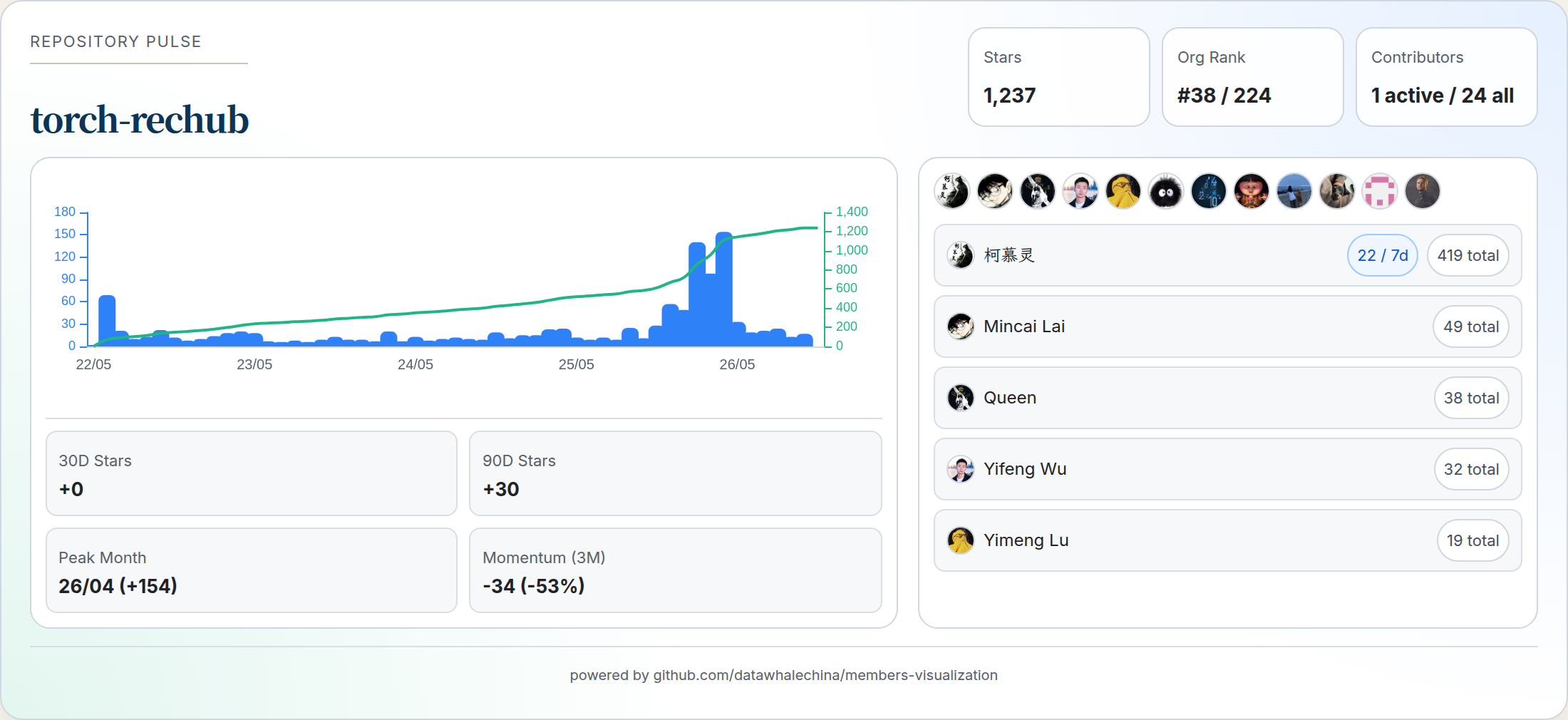
Last updated: [2026-08-03]


评论