







Sonos’ neural-network inference engine.
tract loads ONNX and NNEF models, optimises them, and runs them anywhere —
from embedded ARM CPUs to NVIDIA / Apple GPUs, in the browser via
WebAssembly, or on a Linux / macOS / Windows workstation. It is used in
production at Sonos for wake-word and streaming speech-recognition
workloads, and also runs LLM, text-to-image, and classical CV models with
a particular focus on the translate-once / ship-tiny-runtime story
enabled by its NNEF-based intermediate format (tract-OPL).
Quick start
From examples/onnx-mobilenet-v2:
use tract::prelude::*;
tract::impl_ndarray_interop!();

let model = tract::onnx()?
    .load("mobilenetv2-7.onnx")?
    .into_model()?;

// prepare() optimises and compiles the model for the chosen runtime
let runtime = tract::runtime_for_name("default")?;
let runnable = runtime.prepare(model)?;

let result = runnable.run([input.tract()?])?;
The tract crate (api/rs/src/lib.rs) is the authoritative public API. The
internal crates (tract-core, tract-nnef, tract-onnx, …) are not
stable surface and shouldn’t be depended on directly.
For Python, see the tract package on PyPI.
Examples
examples/ has runnable demos covering the workloads tract
targets today:
Resources
Technical documentation lives under doc/ (start at doc/intro.md);
the doc/cli-recipe.md page collects practical CLI recipes.
The Sonos engineering blog
has a long-form post on tract internals.
Python
tract is also available as the tract package on PyPI,
built on top of the same Rust core:
pip install tract
The API mirrors the Rust pipeline: load a model, set input facts, optimise, then run.
Documentation: sonos.github.io/tract. Source lives in api/py/.
Runtimes
| Runtime |
Name |
Crate |
Notes |
| CPU (x86, ARMv6/7/8, ARM SVE) |
"default" |
tract-linalg |
Default. Hand-rolled SIMD micro-kernels. |
| Apple Metal |
"metal" |
tract-metal |
Apple GPUs. |
| NVIDIA CUDA |
"cuda" |
tract-cuda |
NVIDIA GPUs. |
| WebAssembly |
"default" |
via standard wasm32 targets |
Browser / WASI deployment. |
All runtimes share the TypedModel IR and the same loaders, so a model
optimised on one platform can be moved to another.
Benchmarks
Every night, main is benchmarked on a fleet of devices — Cortex-A7 to
Cortex-A55 boards, RISC-V boards, x86 and Apple desktops, NVIDIA and Apple
GPUs, and WebAssembly — over wake-word, speech recognition, speech
enhancement, vision and LLM models. The bench page
tracks every model on every device. A few of the trends:
| Model |
Target |
Speed |
Trend |
| GTCRN speech enhancement |
Cortex-A55 |
12.1× since Aug 2026 |
 |
| MobileNet v2, multi-thread |
Cortex-A53 |
3.2× since Aug 2026 |
 |
| Parakeet TDT 0.6B preprocessor |
Intel i9-11900KB |
14.7× since Jun 2026 |
 |
| Llama 3.2 3B text generation |
Apple M1 Max, Metal |
1.8× since Apr 2025 |
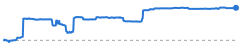 |
Speed is relative to the first week of each series, dashed line at 1×.
doc/bench/sparklines.py regenerates the charts.
Streaming and pulsification
tract has first-class support for pulsified inference: a network that
operates on full sequences during training is translated into one that
processes a fixed-size pulse along its streaming axis at each step. This
lets the same model serve both batch evaluation and low-latency real-time
inference (wake-word, streaming ASR, …).
The translate-time logic lives in tract-pulse; runtime ships only the
small tract-pulse-opl crate. See
doc/overview.md § Streaming and pulsification
for the engineering view, and
examples/nemo-nemotron-streaming-asr
for a working demo.
| Format |
Load |
Save |
| ONNX |
✓ |
— |
| NNEF (+ tract-OPL extensions) |
✓ |
✓ |
| TensorFlow Lite (legacy) |
✓ |
✓ |
| TensorFlow 1 frozen graph (legacy) |
✓ |
— |
PyTorch models can be exported directly to NNEF using
torch-to-nnef
(source), an open-source
PyTorch-to-NNEF converter maintained alongside tract — useful when you want
to skip the detour through ONNX.
tract-OPL is an NNEF-compatible intermediate representation that extends
NNEF with the operators needed to express a full tract-core model. The
recommended deployment workflow is:
- Once, at build time: convert from ONNX / TF / TFLite to NNEF using
the
tract CLI:tract model.onnx dump --nnef model.nnef.tgz
- At runtime: ship only
tract-core + tract-nnef, plus
tract-onnx-opl if the model uses ONNX-only operators, and
tract-pulse-opl if it is pulsified.
This keeps the runtime footprint small (no protobuf, no training-framework
loaders). See doc/intro.md for the full design rationale.
tract-OPL stability
NNEF parts are tied to the NNEF specification and very stable. tract-OPL
extensions are a bit more in flux, but we observe the rule:
A model serialised with tract 0.x.y should work with tract 0.x.z where z >= y.
Models embed a tract_nnef_ser_version property identifying the generating
tract version; tract itself does not enforce a version check, so it is up
to the application to do so if needed. See CHANGELOG.md
for the running list of notable serialisation-format changes.
TensorFlow 1 (legacy)
tract still loads TF1 frozen graphs and supports the operator set needed
for the classical CV and wake-word models that originally drove its design
(Inception v3, Snips wake words, …). TensorFlow 2 is not directly
supported — convert to ONNX first.
License
Files in tensorflow/protos are copied from the
TensorFlow project and files in
onnx/protos from the ONNX project; neither
is covered by the licence statement below.
Apache 2.0 / MIT
All original work is licensed under either of
at your option.
Contribution
Unless you explicitly state otherwise, any Contribution intentionally
submitted for inclusion in the work by you, as defined in the Apache-2.0
license, shall be dual licensed as above, without any additional terms or
conditions.


评论