… image:: /docs/images/logo-small.png
:target: https://github.com/iqm-finland/KQCircuits
:alt: KQCircuits
:width: 300
:align: center
KQCircuits is a Python library developed by IQM for automating the design of
superconducting quantum circuits. It uses the KLayout <https://klayout.de>__ layout design API.
… image:: https://github.com/iqm-finland/KQCircuits/actions/workflows/ci.yaml/badge.svg
:target: https://github.com/iqm-finland/KQCircuits/actions/workflows/ci.yaml
:alt: Continuous Integration
… image:: https://zenodo.org/badge/DOI/10.5281/zenodo.4944796.svg
:target: https://doi.org/10.5281/zenodo.4944796
:alt: DOI
… image:: https://img.shields.io/badge/License-GPLv3-blue.svg
:target: https://github.com/iqm-finland/kqcircuits/blob/master/LICENSE
:alt: License
… image:: https://img.shields.io/pypi/v/kqcircuits
:target: https://pypi.org/project/kqcircuits/
:alt: PyPI Package
… image:: https://img.shields.io/badge/click-for documentation 📒-lightgrey
:target: https://iqm-finland.github.io/KQCircuits/index.html
:alt: Click for documentation
… image:: https://img.shields.io/badge/code style-black-000000.svg
:target: https://github.com/psf/black
:alt: Black badge
KQCircuits generates multi-layer 2-dimensional-geometry representing common structures in quantum
processing units (QPU). It includes definitions of parametrized geometrical objects or “elements”,
framework to easily define your own elements, framework to get geometry from the elements by setting
values to parameters and a framework to assemble a full QPU design by combining many of the elements
in different geometrical relations. Among other templates, are also structures to combine QPU
designs to create optical mask layout and EBL patterns for fabrication of quantum circuits and
export a set of files for a mask as needed for QPU fabrication.
… image:: /docs/images/readme/design_flow.svg
:alt: QPU design workflow
:width: 700
… image:: /docs/images/readme/single_xmons_chip_3.png
:alt: Example layout
Getting started
KQCircuits is a KLayout extension. KLayout can be used either using a graphical user interface or as
a standalone python module. For first time users, the graphical user interface (GUI) mode is recommended.
To get a first introduction to KQCircuits, follow the
Getting started tutorial <https://iqm-finland.github.io/KQCircuits/getting_started/index.html>__. It will show you
how to install and use KQCircuits in the KLayout GUI, how to create your own custom elements and chips in python code,
and explains the basics of the KQCircuits workflow.
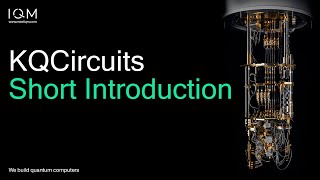
The following video shows some of the KQC features:
… image:: https://img.youtube.com/vi/9ra_5s2i3eU/mqdefault.jpg
:target: https://youtu.be/9ra_5s2i3eU
:alt: KQCircuits Getting Started
Installation (Klayout GUI)
^^^^^^^^^^^^^^^^^^^^^^^^^^
First install KLayout <https://iqm-finland.github.io/KQCircuits/installation/klayout.html>__.
Then, KQCircuits can be installed in two ways:
As a Salt package directly from KLayout <https://iqm-finland.github.io/KQCircuits/getting_started/salt.html>__.
This allows you to use the KQCircuits chips and elements, and create a user package for your own custom designs.- Download the GIT repository, and follow the
Developer GUI setup <https://iqm-finland.github.io/KQCircuits/developer/setup.html>__.
Choose this if you want to modify the KQCircuits code and possibly contribute to the project.
You can always switch from Salt package to developer setup later on.
Installation as standalone python module
^^^^^^^^^^^^^^^^^^^^^^^^^^^^^^^^^^^^^^^^
Installing KQCircuits as a stand alone python module <https://iqm-finland.github.io/KQCircuits/developer/standalone.html>__
allows you to use KQCircuits features in your own python code with:
… code-block:: console
import kqcircuits
You will also get access to kqc related terminal commands such as:
… code-block:: console
kqc mask quick_demo.py # To build a wafer mask, in this case quick_demo.py
kqc sim waveguides_sim_compare.py # To export and run waveguide simulation
For standalone installation run command
… code-block:: console
python -m pip install -e “klayout_package/python[dev,sim]”
For further installation details when it comes
to setting up a reproducible KQCircuits python environment, see this documentation <https://iqm-finland.github.io/KQCircuits/developer/standalone.html>__.
Documentation
Documentation for KQCircuits can be found here <https://iqm-finland.github.io/KQCircuits/>__.
It may also be generated from the sources with make html in the docs directory.
Tutorials
^^^^^^^^^
Follow the Getting started <https://iqm-finland.github.io/KQCircuits/getting_started/index.html>__ section for tutorials.
… image:: /docs/images/gui_workflows/converting_gui_elements_to_code.gif
:target: https://iqm-finland.github.io/KQCircuits/getting_started/gui_features/gui_elements_to_code.html
:alt: Example of GUI elements
:width: 600
Simulations
… image:: /docs/images/readme/xmon_animation.gif
:alt: Animation of simulations
:width: 350
KQC currently supports exporting to Ansys HFSS/Q3D (also with pyEPR), Elmer, and Sonnet.
Parameter sweeps are easy to implement, for example
… code-block:: python
simulations = sweep_simulation(layout, SimClass, sim_parameters, {
‘cpl_length’: [160, 180, 200],
‘arm_width’: [24, 28, 32, 36],
})
exports simulations with the given individual parameters varied roughly as in the animation.
A sweep of all possible combinations between the given parameters is done by changing the function to
cross_sweep_simulation.
Check klayout_package/python/scripts/simulations <https://github.com/iqm-finland/KQCircuits/tree/main/klayout_package/python/scripts/simulations>__
for example simulation exports.
Support
If you have any questions, problems or ideas related to KQCircuits, please start
a
discussion in GitHub <https://github.com/iqm-finland/KQCircuits/discussions>__
or create a GitHub issue <https://github.com/iqm-finland/KQCircuits/issues>__.
Contributing
Contributions to KQC are welcome from the community. Contributors are expected to accept IQM
Individual Contributor License Agreement by filling a form at IQM website <https://www.meetiqm.com/technology/iqm-kqcircuits/iqm-individual-contributor-license-agreement/>.
See also section Contributing <https://iqm-finland.github.io/KQCircuits/contributing.html> in the
documentation.
Citation
Please see the
documentation <https://iqm-finland.github.io/KQCircuits/citing.html>__
for instructions on how to cite KQCircuits in your projects and publications.
Copyright
This code is part of KQCircuits
Copyright © 2021-2026 IQM Finland Oy
This program is free software: you can redistribute it and/or modify it under the terms of the GNU General Public
License as published by the Free Software Foundation, either version 3 of the License, or (at your option) any later
version.
This program is distributed in the hope that it will be useful, but WITHOUT ANY WARRANTY; without even the implied
warranty of MERCHANTABILITY or FITNESS FOR A PARTICULAR PURPOSE. See the GNU General Public License for more details.
You should have received a copy of the GNU General Public License along with this program. If not, see
https://www.gnu.org/licenses/gpl-3.0.html.
The software distribution should follow IQM trademark policy for open-source software
(meetiqm.com/iqm-open-source-trademark-policy <https://meetiqm.com/iqm-open-source-trademark-policy/>).
IQM welcomes contributions to the code. Please see our contribution agreements for individuals
(meetiqm.com/iqm-individual-contributor-license-agreement <https://meetiqm.com/iqm-individual-contributor-license-agreement/>)
and organizations (meetiqm.com/iqm-organization-contributor-license-agreement <https://meetiqm.com/iqm-organization-contributor-license-agreement/>__).
Trademarks
KQCircuits is a registered trademark of IQM. Please see
IQM open source software trademark policy <https://meetiqm.com/iqm-open-source-trademark-policy>__.


评论