/*
cr.h
A single file header-only live reload solution for C, written in C++:
- simple public API, 3 functions to use only (and another to export);
- works and tested on Linux, MacOSX and Windows;
- automatic crash protection;
- automatic static state transfer;
- based on dynamic reloadable binary (.so/.dylib/.dll);
- support multiple plugins;
- MIT licensed;
NOTE: The only file that matters in this repository is cr.h.
This file contains the documentation in markdown, the license, the implementation and the public api.
All other files in this repository are supporting files and can be safely ignored.
Building cr - Using vcpkg
You can download and install cr using the vcpkg dependency manager:
git clone https://github.com/Microsoft/vcpkg.git
cd vcpkg
./bootstrap-vcpkg.sh
./vcpkg integrate install
./vcpkg install cr
The cr port in vcpkg is kept up to date by Microsoft team members and community contributors. If the version is out of date, please create an issue or pull request on the vcpkg repository.
Example
A (thin) host application executable will make use of cr to manage
live-reloading of the real application in the form of dynamic loadable binary, a host would be something like:
#define CR_HOST // required in the host only and before including cr.h
#include "cr.h"

int main(int argc, char *argv[]) {
    // the host application should initialize a plugin with a context, a plugin
    cr_plugin ctx;

    // the full path to the live-reloadable application
    cr_plugin_open(ctx, "c:/path/to/build/game.dll");

    // call the update function at any frequency matters to you, this will give
    // the real application a chance to run
    while (!cr_plugin_update(ctx)) {
        // do anything you need to do on host side (ie. windowing and input stuff?)
    }

    // at the end do not forget to cleanup the plugin context
    cr_plugin_close(ctx);
    return 0;
}
While the guest (real application), would be like:
CR_EXPORT int cr_main(struct cr_plugin *ctx, enum cr_op operation) {
    assert(ctx);
    switch (operation) {
        case CR_LOAD:   return on_load(...); // loading back from a reload
        case CR_UNLOAD: return on_unload(...); // preparing to a new reload
        case CR_CLOSE: ...; // the plugin will close and not reload anymore
    }
    // CR_STEP
    return on_update(...);
}
Changelog
2025-03-30
- Removed FIPS and moved to pure CMake.
- As a result, cr.h has been moved into the cr directory.
- Using cr as a cmake dependency (
target_link_libraries(<my_target> PRIVATE cr)) will expose the cr.h header file to the target.
2020-04-19
- Added a failure
CR_INITIAL_FAILURE. If the initial plugin crashes, the host must determine the next path, and we will not reload
the broken plugin.
2020-01-09
- Deprecated
cr_plugin_load in favor to cr_plugin_open for consistency with cr_plugin_close. See issue #49.
- Minor documentation improvements.
2018-11-17
- Support to OSX finished, thanks to MESH Consultants Inc.
- Added a new possible failure
CR_BAD_IMAGE in case the binary file is still not ready even if its timestamp changed. This could happen if generating the file (compiler or copying) was slow.
- Windows: Fix issue with too long paths causing the PDB patch process to fail, causing the reload process to fail.
- Possible breaking change: Fix rollback flow. Before, during a rollback (for any reason) two versions were decremented one-shot so that the in following load, the version would bump again getting us effectively on the previous version, but in some cases not related to crashes this wasn’t completely valid (see
CR_BAD_IMAGE). Now the version is decremented one time in the crash handler and then another time during the rollback and then be bumped again. A rollback due an incomplete image will not incorrectly rollback two versions, it will continue at the same version retrying the load until the image is valid (copy or compiler finished writing to it). This may impact current uses of cr if the version info is used during CR_UNLOAD as it will now be a different value.
Samples
Two simple samples can be found in the samples directory.
The first is one is a simple console application that demonstrate some basic static
states working between instances and basic crash handling tests. Print to output
is used to show what is happening.
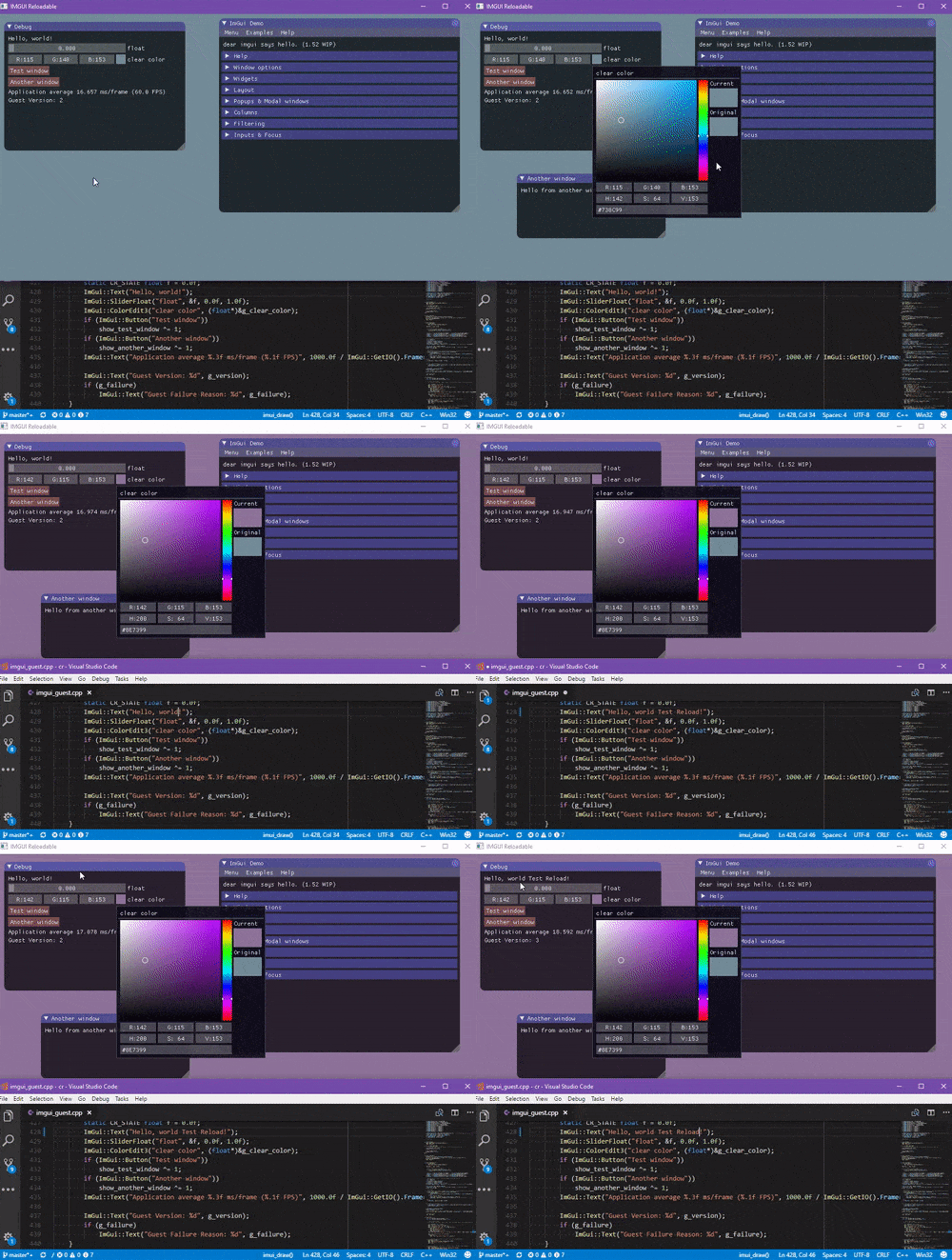
The second one demonstrates how to live-reload an opengl application using
Dear ImGui. Some state lives in the host
side while most of the code is in the guest side.
Samples and Tests
To build, use the given CMake preset:
$ cmake --preset Default .
$ cmake --build build
To run the tests, you can use the vscode Launch Tests option (Windows only, currently), or:
$ cd build/tests
$ ctest build
To use the basic sample, you can use the vscode Launch basic sample option (Windows only, currently), or:
$ cd build/samples/basic
$ ./basic_host # or basic_host_b

# Edit basic_guest.c, or just:
$ touch basic_guest.c

# rebuild
$ cmake --build ../../
For the imgui sample, after building:
$ cd build/samples/imgui
$ ./imgui_host

# Edit imgui_guest.cpp, or just:
$ touch imgui_guest.cpp

# rebuild
$ cmake --build ../../
Documentation
int (*cr_main)(struct cr_plugin *ctx, enum cr_op operation)
This is the function pointer to the dynamic loadable binary entry point function.
Arguments
ctx pointer to a context that will be passed from host to the guest containing valuable information about the current loaded version, failure reason and user data. For more info see cr_plugin.operation which operation is being executed, see cr_op.
Return
- A negative value indicating an error, forcing a rollback to happen and failure
being set to
CR_USER. 0 or a positive value that will be passed to the
host process.
bool cr_plugin_open(cr_plugin &ctx, const char *fullpath)
Loads and initialize the plugin.
Arguments
ctx a context that will manage the plugin internal data and user data.fullpath full path with filename to the loadable binary for the plugin or
NULL.
Return
true in case of success, false otherwise.
void cr_set_temporary_path(cr_plugin& ctx, const std::string &path)
Sets temporary path to which temporary copies of plugin will be placed. Should be called
immediately after cr_plugin_open(). If temporary path is not set, temporary copies of
the file will be copied to the same directory where the original file is located.
Arguments
ctx a context that will manage the plugin internal data and user data.path a full path to an existing directory which will be used for storing temporary plugin copies.
int cr_plugin_update(cr_plugin &ctx, bool reloadCheck = true)
This function will call the plugin cr_main function. It should be called as
frequently as the core logic/application needs.
Arguments
ctx the current plugin context data.reloadCheck optional: do a disk check (stat()) to see if the dynamic library needs a reload.
Return
- -1 if a failure happened during an update;
- -2 if a failure happened during a load or unload;
- anything else is returned directly from the plugin
cr_main.
void cr_plugin_close(cr_plugin &ctx)
Cleanup internal states once the plugin is not required anymore.
Arguments
ctx the current plugin context data.
cr_op
Enum indicating the kind of step that is being executed by the host:
CR_LOAD A load caused by reload is being executed, can be used to restore any
saved internal state.CR_STEP An application update, this is the normal and most frequent operation;CR_UNLOAD An unload for reloading the plugin will be executed, giving the
application one chance to store any required data;CR_CLOSE Used when closing the plugin, This works like CR_UNLOAD but no CR_LOAD
should be expected afterwards;
cr_plugin
The plugin instance context struct.
p opaque pointer for internal cr data;userdata may be used by the user to pass information between reloads;version incremetal number for each succeded reload, starting at 1 for the
first load. The version will change during a crash handling process;failure used by the crash protection system, will hold the last failure error
code that caused a rollback. See cr_failure for more info on possible values;
cr_failure
If a crash in the loadable binary happens, the crash handler will indicate the
reason of the crash with one of these:
CR_NONE No error;CR_SEGFAULT Segmentation fault. SIGSEGV on Linux/OSX or
EXCEPTION_ACCESS_VIOLATION on Windows;CR_ILLEGAL In case of illegal instruction. SIGILL on Linux/OSX or
EXCEPTION_ILLEGAL_INSTRUCTION on Windows;CR_ABORT Abort, SIGBRT on Linux/OSX, not used on Windows;CR_MISALIGN Bus error, SIGBUS on Linux/OSX or EXCEPTION_DATATYPE_MISALIGNMENT
on Windows;CR_BOUNDS Is EXCEPTION_ARRAY_BOUNDS_EXCEEDED, Windows only;CR_STACKOVERFLOW Is EXCEPTION_STACK_OVERFLOW, Windows only;CR_STATE_INVALIDATED Static CR_STATE management safety failure;CR_BAD_IMAGE The plugin is not a valid image (i.e. the compiler may still
writing it);CR_OTHER Other signal, Linux only;CR_USER User error (for negative values returned from cr_main);
CR_HOST define
This define should be used before including the cr.h in the host, if CR_HOST
is not defined, cr.h will work as a public API header file to be used in the
guest implementation.
Optionally CR_HOST may also be defined to one of the following values as a way
to configure the safety operation mode for automatic static state management
(CR_STATE):
CR_SAFEST Will validate address and size of the state data sections during
reloads, if anything changes the load will rollback;CR_SAFE Will validate only the size of the state section, this mean that the
address of the statics may change (and it is best to avoid holding any pointer
to static stuff);CR_UNSAFE Will validate nothing but that the size of section fits, may not
be necessarily exact (growing is acceptable but shrinking isn’t), this is the
default behavior;CR_DISABLE Completely disable automatic static state management;
CR_STATE macro
Used to tag a global or local static variable to be saved and restored during a reload.
Usage
static bool CR_STATE bInitialized = false;
Overridable macros
You can define these macros before including cr.h in host (CR_HOST) to customize cr.h
memory allocations and other behaviours:
CR_MAIN_FUNC: changes ‘cr_main’ symbol to user-defined function name. default: #define CR_MAIN_FUNC “cr_main”CR_ASSERT: override assert. default: #define CA_ASSERT(e) assert(e)CR_REALLOC: override libc’s realloc. default: #define CR_REALLOC(ptr, size) ::realloc(ptr, size)CR_MALLOC: override libc’s malloc. default: #define CR_MALLOC(size) ::malloc(size)CR_FREE: override libc’s free. default: #define CR_FREE(ptr) ::free(ptr)CR_DEBUG: outputs debug messages in CR_ERROR, CR_LOG and CR_TRACECR_ERROR: logs debug messages to stderr. default (CR_DEBUG only): #define CR_ERROR(…) fprintf(stderr, VA_ARGS)CR_LOG: logs debug messages. default (CR_DEBUG only): #define CR_LOG(…) fprintf(stdout, VA_ARGS)CR_TRACE: prints function calls. default (CR_DEBUG only): #define CR_TRACE(…) fprintf(stdout, “CR_TRACE: %s\n”, FUNCTION)
FAQ / Troubleshooting
Q: Why?
A: Read about why I made this here.
Q: My application asserts/crash when freeing heap data allocated inside the dll, what is happening?
A: Make sure both your application host and your dll are using the dynamic
run-time (/MD or /MDd) as any data allocated in the heap must be freed with
the same allocator instance, by sharing the run-time between guest and
host you will guarantee the same allocator is being used.
Q: Can we load multiple plugins at the same time?
A: Yes. This should work without issues on Windows. On Linux and OSX there may be
issues with crash handling
Q: You said this wouldn’t lock my PDB, but it still locks! Why?
If you had to load the dll before cr for any reason, Visual Studio may still hold a lock to the PDB. You may be having this issue and the solution is here.
Q: Hot-reload is not working at all, what I’m doing wrong?
First, be sure that your build system is not interfering by somewhat still linking to your shared library. There are so many things that can go wrong and you need to be sure only cr will deal with your shared library. On linux, for more info on how to find what is happening, check this issue.
Q: How much can I change things in the plugin without risking breaking everything?
cr is C reloader and dealing with C it assume simple things will mostly work.
The problem is how the linker will decide do rearrange things accordingly the amount of changes you do in the code. For incremental and localized changes I never had any issues, in general I hardly had any issues at all by writing normal C code. Now, when things start to become more complex and bordering C++, it becomes riskier. If you need do complex things, I suggest checking RCCPP and reading this PDF and my original blog post about cr here.
With all these information you’ll be able to decide which is better to your use case.

For sponsoring the port of cr to the MacOSX.
Contributors
Danny Grein
Rokas Kupstys
Noah Rinehart
Niklas Lundberg
Sepehr Taghdisian
Robert Gabriel Jakabosky
@pixelherodev
Alexander
Vikram Saran
Contributing
We welcome ALL contributions, there is no minor things to contribute with, even one letter typo fixes are welcome.
The only things we require is to test thoroughly, maintain code style and keeping documentation up-to-date.
Also, accepting and agreeing to release any contribution under the same license.
License
The MIT License (MIT)
Copyright © 2017 Danny Angelo Carminati Grein
Permission is hereby granted, free of charge, to any person obtaining a copy of
this software and associated documentation files (the “Software”), to deal in
the Software without restriction, including without limitation the rights to
use, copy, modify, merge, publish, distribute, sublicense, and/or sell copies of
the Software, and to permit persons to whom the Software is furnished to do so,
subject to the following conditions:
The above copyright notice and this permission notice shall be included in all
copies or substantial portions of the Software.
THE SOFTWARE IS PROVIDED “AS IS”, WITHOUT WARRANTY OF ANY KIND, EXPRESS OR
IMPLIED, INCLUDING BUT NOT LIMITED TO THE WARRANTIES OF MERCHANTABILITY, FITNESS
FOR A PARTICULAR PURPOSE AND NONINFRINGEMENT. IN NO EVENT SHALL THE AUTHORS OR
COPYRIGHT HOLDERS BE LIABLE FOR ANY CLAIM, DAMAGES OR OTHER LIABILITY, WHETHER
IN AN ACTION OF CONTRACT, TORT OR OTHERWISE, ARISING FROM, OUT OF OR IN
CONNECTION WITH THE SOFTWARE OR THE USE OR OTHER DEALINGS IN THE SOFTWARE.
Source
View Source Code
*/
#ifndef __CR_H__
#define __CR_H__

//
// Global OS specific defines/customizations
//
#if defined(_WIN32)
#define CR_WINDOWS
#define CR_PLUGIN(name) "" name ".dll"
#elif defined(__linux__)
#define CR_LINUX
#define CR_PLUGIN(name) "lib" name ".so"
#elif defined(__APPLE__)
#define CR_OSX
#define CR_PLUGIN(name) "lib" name ".dylib"
#else
#error "Unknown/unsupported platform, please open an issue if you think this \
platform should be supported."
#endif // CR_WINDOWS || CR_LINUX || CR_OSX

//
// Global compiler specific defines/customizations
//
#if defined(_MSC_VER)
#if defined(__cplusplus)
#define CR_EXPORT extern "C" __declspec(dllexport)
#define CR_IMPORT extern "C" __declspec(dllimport)
#else
#define CR_EXPORT __declspec(dllexport)
#define CR_IMPORT __declspec(dllimport)
#endif
#endif // defined(_MSC_VER)

#if defined(__GNUC__) // clang & gcc
#if defined(__cplusplus)
#define CR_EXPORT extern "C" __attribute__((visibility("default")))
#else
#define CR_EXPORT __attribute__((visibility("default")))
#endif
#define CR_IMPORT
#endif // defined(__GNUC__)

#if defined(__MINGW32__)
#undef CR_EXPORT
#if defined(__cplusplus)
#define CR_EXPORT  extern "C" __declspec(dllexport)
#else
#define CR_EXPORT  __declspec(dllexport)
#endif
#endif

// cr_mode defines how much we validate global state transfer between
// instances. The default is CR_UNSAFE, you can choose another mode by
// defining CR_HOST, ie.: #define CR_HOST CR_SAFEST
enum cr_mode {
    CR_SAFEST = 0, // validate address and size of the state section, if
                   // anything changes the load will rollback
    CR_SAFE = 1,   // validate only the size of the state section, this means
                   // that address is assumed to be safe if avoided keeping
                   // references to global/static states
    CR_UNSAFE = 2, // don't validate anything but that the size of the section
                   // fits, may not be identical though
    CR_DISABLE = 3 // completely disable the auto state transfer
};

// cr_op is passed into the guest process to indicate the current operation
// happening so the process can manage its internal data if it needs.
enum cr_op {
    CR_LOAD = 0,
    CR_STEP = 1,
    CR_UNLOAD = 2,
    CR_CLOSE = 3,
};

enum cr_failure {
    CR_NONE,     // No error
    CR_SEGFAULT, // SIGSEGV / EXCEPTION_ACCESS_VIOLATION
    CR_ILLEGAL,  // illegal instruction (SIGILL) / EXCEPTION_ILLEGAL_INSTRUCTION
    CR_ABORT,    // abort (SIGBRT)
    CR_MISALIGN, // bus error (SIGBUS) / EXCEPTION_DATATYPE_MISALIGNMENT
    CR_BOUNDS,   // EXCEPTION_ARRAY_BOUNDS_EXCEEDED
    CR_STACKOVERFLOW, // EXCEPTION_STACK_OVERFLOW
    CR_STATE_INVALIDATED, // one or more global data section changed and does
                          // not safely match basically a failure of
                          // cr_plugin_validate_sections
    CR_BAD_IMAGE, // The binary is not valid - compiler is still writing it
    CR_INITIAL_FAILURE, // Plugin version 1 crashed, cannot rollback
    CR_OTHER,    // Unknown or other signal,
    CR_USER = 0x100,
};

struct cr_plugin;

typedef int (*cr_plugin_main_func)(struct cr_plugin *ctx, enum cr_op operation);

// public interface for the plugin context, this has some user facing
// variables that may be used to manage reload feedback.
// - userdata may be used by the user to pass information between reloads
// - version is the reload counter (after loading the first instance it will
//   be 1, not 0)
// - failure is the (platform specific) last error code for any crash that may
//   happen to cause a rollback reload used by the crash protection system
struct cr_plugin {
    void *p;
    void *userdata;
    unsigned int version;
    enum cr_failure failure;
    unsigned int next_version;
    unsigned int last_working_version;
};

#ifndef CR_HOST

// Guest specific compiler defines/customizations
#if defined(_MSC_VER)
#pragma section(".state", read, write)
#define CR_STATE __declspec(allocate(".state"))
#endif // defined(_MSC_VER)

#if defined(CR_OSX)
#define CR_STATE __attribute__((used, section("__DATA,__state")))
#else
#if defined(__GNUC__) // clang & gcc
#define CR_STATE __attribute__((section(".state")))
#endif // defined(__GNUC__)
#endif

#else // #ifndef CR_HOST

// Overridable macros
#ifndef CR_LOG
#   ifdef CR_DEBUG
#       include <stdio.h>
#       define CR_LOG(...)     fprintf(stdout, __VA_ARGS__)
#   else
#       define CR_LOG(...)
#   endif
#endif

#ifndef CR_ERROR
#   ifdef CR_DEBUG
#       include <stdio.h>
#       define CR_ERROR(...)     fprintf(stderr, __VA_ARGS__)
#   else
#       define CR_ERROR(...)
#   endif
#endif

#ifndef CR_TRACE
#   ifdef CR_DEBUG
#       include <stdio.h>
#       define CR_TRACE        fprintf(stdout, "CR_TRACE: %s\n", __FUNCTION__);
#   else
#       define CR_TRACE
#   endif
#endif

#ifndef CR_MAIN_FUNC
#   define CR_MAIN_FUNC "cr_main"
#endif

#ifndef CR_ASSERT
#   include <assert.h>
#   define CR_ASSERT(e)             assert(e)
#endif

#ifndef CR_REALLOC
#   include <stdli

提示:代码过长已自动截断



评论