DDC Skills Collection for AI Coding Assistants
AI Tools for Construction Company Automation


Works with any AI coding assistant:


What is this?
A collection of 238 skills for automating construction company processes with AI coding assistants.
What is a “Skill”?
A skill is a SKILL.md file — structured instructions that an AI coding assistant can read and execute. Each skill describes a specific task: what problem it solves, what code to generate, and what tools are needed. You open a skill folder in your AI assistant, and it helps you implement the described functionality.
Collection Structure
Skills are organized by source and complexity level:
| Category |
What’s inside |
Skills |
Start here if… |
| 1_DDC_Toolkit |
Production-ready tools: CWICR database, CAD converters, analytics |
85 |
You need a working tool now |
| 2_DDC_Book |
Skills mapped to book chapters: data evolution, types, estimation, ML |
67 |
You want to follow a structured learning path |
| 3_DDC_Insights |
Practical workflows: n8n automation, AI agents, field tools |
20 |
You need workflow automation |
| 4_DDC_Curated |
Document generation (PDF, Excel, DOCX, PPTX), quality checks |
20 |
You need document or report templates |
| 5_DDC_Innovative |
Advanced: computer vision, IoT, digital twins, risk assessment, AI agents, ESG, EU AI Act, circular construction, generative design |
34 |
You’re ready for AI/ML experimentation |
| 6_OpenConstructionERP |
Work with the OpenConstructionERP platform: load cost bases, BOQ & estimating, BIM takeoff, 4D/5D, cost browser, MCP, field ops, tendering, validation, geo/coordination, property development |
12 |
You build on the open-source construction ERP |
mindmap
root((DDC Skills<br/>238 skills))
1_DDC_Toolkit
CWICR Database
8 national bases
30 markets · 26 languages
CAD Converters
RVT → Excel
IFC → Excel
DWG → Excel
Analytics
KPI Dashboard
Cost Analysis
2_DDC_Book
Part I: Data Evolution
Part II: Data Types
Part III: Estimation
Part IV: Analytics & ML
Part V: Threats & Strategy
3_DDC_Insights
n8n Workflows
Daily Reports
Photo Reports
AI Agents 2026
Field Automation
4_DDC_Curated
Document Generation
PDF, Excel
DOCX, PPTX
Quality Assurance
5_DDC_Innovative
AI/ML Skills
Defect Detection
Risk Assessment
IoT & Sensors
Advanced BIM
Digital Twin
AI Agent Orchestration
Embodied Carbon & ESG
EU AI Act
Material Passports
Generative Design
6_OpenConstructionERP
Load Cost Bases
TR · ZH · BR · ES · IT
VN · ID · GR · 30 markets
BOQ & Estimating
BIM & CAD Takeoff
4D/5D Scheduling
Cost Browser
MCP Integration
Field Ops · Tendering
Validation · Geo Hub
Property Development
Where to Start
If you manage or lead a construction company:
Step 1. Read GETTING_STARTED.md — a non-technical overview of what can be automated and how to prioritize.
Step 2. Download the Data-Driven Construction book (free, 31 languages) — it explains the methodology behind these skills: how to assess your company’s data maturity, identify bottlenecks, and plan digital transformation.
Step 3. Identify your biggest pain point in the table below and start with the corresponding skill.
If you are a developer or IT lead:
Step 1. Install prerequisites (see Prerequisites).
Step 2. Pick a skill from the table below, open its folder in your AI assistant, and follow the SKILL.md.
Step 3. Adapt the generated code to your data and deploy.
What Can You Automate?
Examples of common problems and which skills address them:
| Your problem |
What the skill does |
Skill to run |
Folder |
| Searching for work item rates takes too long |
Semantic search across 78,228 national + 55,719 global items in 26 languages |
semantic-search-cwicr |
1_DDC_Toolkit/ |
| Estimators spend days building estimates manually |
Generates estimates from historical data and templates |
estimate-builder |
1_DDC_Toolkit/ |
| BIM models contain data but it’s locked in RVT/IFC files |
Extracts quantities and properties to Excel |
ifc-to-excel, rvt-to-excel |
1_DDC_Toolkit/ |
| Daily/weekly reports take hours to compile |
Automated data collection and report generation |
n8n-daily-report |
3_DDC_Insights/ |
| Site photos pile up with no organization |
AI classifies and tags site photos automatically |
n8n-photo-report |
3_DDC_Insights/ |
| Data is scattered across Excel files, emails, PDFs |
Finds all data sources and maps dependencies |
data-silo-detection |
2_DDC_Book/ |
| No visibility into project KPIs |
Dashboard with real-time metrics from your data |
kpi-dashboard |
1_DDC_Toolkit/ |
| Budget overruns discovered too late |
Scheduled budget vs. actual comparison |
budget-tracker |
1_DDC_Toolkit/ |
| PDF specifications need to be searchable |
Extracts text and tables from PDFs into structured data |
specification-extractor |
2_DDC_Book/ |
| Schedule delays are hard to predict |
Statistical analysis of schedule variance patterns |
schedule-delay-analyzer |
3_DDC_Insights/ |
This is a selection of examples. The full collection contains 221 skills covering estimation, reporting, BIM, document processing, analytics, and more.
How to Use a Skill
1. Clone this repository
   git clone https://github.com/datadrivenconstruction/DDC_Skills_for_AI_Agents_in_Construction.git

2. Open a skill folder in your AI assistant
   cd DDC_Skills_for_AI_Agents_in_Construction/1_DDC_Toolkit/CWICR-Database/semantic-search-cwicr/

3. The assistant reads SKILL.md and generates the code for you

4. Review, adapt to your data, and run
Example: ETL Pipeline
# Automatic processing of all Excel files from a folder

import pandas as pd
from pathlib import Path

# Extract
all_data = [pd.read_excel(f) for f in Path("./estimates/").glob("*.xlsx")]
df = pd.concat(all_data)

# Transform
df['Total'] = df['Quantity'] * df['Unit_Price']
summary = df.groupby('Category')['Total'].sum()

# Load
summary.to_excel("summary_report.xlsx")
Implementation Path
A typical automation project follows these stages. You don’t need to do all of them — start with what solves your most pressing problem.
| Stage |
What you do |
Which skills help |
| 1. Audit |
List all data sources in your company (Excel files, databases, BIM models, PDFs, emails) |
data-silo-detection, data-source-audit |
| 2. Classify |
Understand what data you have: structured, semi-structured, or unstructured |
data-type-classifier, data-profiler |
| 3. Connect |
Build ETL pipelines to extract and normalize data |
etl-pipeline, ifc-to-excel, specification-extractor |
| 4. Automate |
Set up recurring reports, alerts, and dashboards |
n8n-daily-report, kpi-dashboard, budget-tracker |
| 5. Analyze |
Apply analytics and ML to find patterns and predict outcomes |
cost-prediction, schedule-forecaster, risk-assessment |
Each stage builds on the previous one, but you can enter at any point depending on your current state.
How Does It Work?
Each step in the implementation path corresponds to specific skills and tools:
flowchart LR
subgraph S1["STEP 1"]
A[Audit<br/>Find Data Silos]
end
subgraph S2["STEP 2"]
B[Classify<br/>Data Types]
end
subgraph S3["STEP 3"]
C[Connect<br/>ETL Pipelines]
end
subgraph S4["STEP 4"]
D[Automate<br/>Reports & Dashboards]
end
subgraph S5["STEP 5"]
E[Analyze<br/>ML & Predictions]
end
A --> B --> C --> D --> E
A1[data-silo-detection<br/>data-source-audit] -.-> A
B1[data-type-classifier<br/>data-profiler] -.-> B
C1[etl-pipeline<br/>ifc-to-excel] -.-> C
D1[n8n-daily-report<br/>kpi-dashboard] -.-> D
E1[cost-prediction<br/>schedule-forecaster] -.-> E
style S1 fill:#ffebee
style S2 fill:#fff3e0
style S3 fill:#e8f5e9
style S4 fill:#e3f2fd
style S5 fill:#f3e5f5
Data Types in Construction
Construction data comes in three forms. Each requires a different processing approach, and each has corresponding skills:
flowchart TB
subgraph STRUCTURED["STRUCTURED"]
S1[Excel]
S2[SQL Database]
S3[CSV]
end
subgraph SEMI["SEMI-STRUCTURED"]
M1[IFC/BIM]
M2[JSON]
M3[XML]
end
subgraph UNSTRUCTURED["UNSTRUCTURED"]
U1[PDF]
U2[Photos]
U3[Scans]
end
STRUCTURED -->|SQL queries, pandas| DB[(Central<br/>Database)]
SEMI -->|ifcopenshell, parsers| DB
UNSTRUCTURED -->|AI/OCR, pdfplumber| DB
DB --> AUTO[Automation & Analytics]
style STRUCTURED fill:#c8e6c9
style SEMI fill:#fff9c4
style UNSTRUCTURED fill:#ffcdd2
style DB fill:#e1f5fe
style AUTO fill:#f3e5f5
| Data type |
Examples |
Skills that process it |
| Structured |
Excel, CSV, SQL databases |
etl-pipeline, estimate-builder, budget-tracker |
| Semi-structured |
IFC/BIM models, JSON, XML |
ifc-to-excel, rvt-to-excel, dwg-to-excel |
| Unstructured |
PDF documents, photos, scans |
specification-extractor, n8n-photo-report, document-ocr |
Prerequisites
| Requirement |
Details |
| Python 3.9+ |
Most skills use Python scripts |
| AI Coding Assistant |
Claude Code, Cursor, Copilot, or similar |
| Basic Python knowledge |
Ability to run scripts and install packages |
| Your data |
Excel files, PDFs, or BIM models to process |
Optional for advanced skills:
- Docker (for n8n workflows)
- PostgreSQL or SQLite (for database skills)
- OpenAI API key (for LLM-based skills)
Installation
pip install pandas openpyxl ifcopenshell pdfplumber
Data Flow in Construction
Skills cover the typical data pipeline: from raw input files to processed, actionable outputs.
flowchart LR
subgraph INPUT["📥 YOUR DATA"]
A1[Excel Estimates]
A2[Revit/IFC Models]
A3[Site Photos]
A4[PDF Documents]
end
subgraph DDC["⚙️ DDC SKILLS"]
B1[ETL Pipeline]
B2[IFC Parser]
B3[AI Analysis]
B4[Document OCR]
end
subgraph OUTPUT["📤 RESULTS"]
C1[Auto Reports]
C2[Auto Estimates]
C3[Progress Tracking]
C4[Searchable Data]
end
A1 --> B1 --> C1
A2 --> B2 --> C2
A3 --> B3 --> C3
A4 --> B4 --> C4
style INPUT fill:#e1f5fe
style DDC fill:#fff3e0
style OUTPUT fill:#e8f5e9
Construction data comes in three forms. Each requires a different processing approach:
| Data type |
Examples |
How skills process it |
| Structured |
Excel, CSV, SQL databases |
Direct queries and transformations |
| Semi-structured |
IFC/BIM models, JSON, XML |
Parsing with specialized libraries |
| Unstructured |
PDF documents, photos, scans |
AI/OCR extraction to structured format |
Folder Structure
DDC_Skills/
│
├── 1_DDC_Toolkit/              ← Production tools (85 skills)
│   ├── CWICR-Database/         ← 8 national bases + 30 markets database
│   ├── CAD-Converters/         ← Revit/IFC/DWG → Excel
│   └── ...
│
├── 2_DDC_Book/                 ← Skills from the book (67 skills)
│   ├── 1.1-Data-Evolution/     ← Digital maturity assessment
│   ├── 1.2-Data-Silos-Integration/  ← Find & connect data sources
│   ├── 3.1-Cost-Estimation/    ← Build estimates from data
│   ├── 4.2-ETL-Automation/     ← Automate data pipelines
│   └── ...
│
├── 3_DDC_Insights/             ← Practical workflows (20 skills)
│   ├── Automation-Workflows/   ← n8n automation
│   ├── AI-Agents/              ← Multi-agent systems (2026)
│   ├── Field-Automation/       ← Telegram bot, voice reports
│   └── Open-Data-Transparency/ ← Uberization readiness
│
├── 4_DDC_Curated/              ← External skills (20 skills)
│   ├── Document-Generation/    ← PDF/Excel/DOCX/PPTX generation
│   └── Quality-Assurance/      ← Quality checks
│
├── 5_DDC_Innovative/           ← Advanced AI/ML skills (29 skills)
│   ├── defect-detection-ai/    ← Computer vision for defects
│   ├── digital-twin-sync/      ← Real-time BIM sync
│   └── ...
│
├── Books/                      ← Free book downloads (31 languages)
├── GETTING_STARTED.md          ← START HERE
└── README.md                   ← You are here
Documentation
Potential Time Savings
Automation results vary depending on company size, data quality, and implementation effort:
| Process |
Manual approach |
With automation |
| Find work item rate |
Search through price books |
Database query with filters |
| Daily report compilation |
Collect data from multiple sources |
Pre-configured data aggregation |
| IFC quantity extraction |
Open model, measure manually |
Script-based extraction to Excel |
| Budget variance tracking |
Weekly spreadsheet updates |
Scheduled comparison reports |
| Document organization |
Manual folder sorting |
Metadata-based classification |
Results depend on data preparation and workflow complexity. See GETTING_STARTED.md for implementation guidance.
About the Book
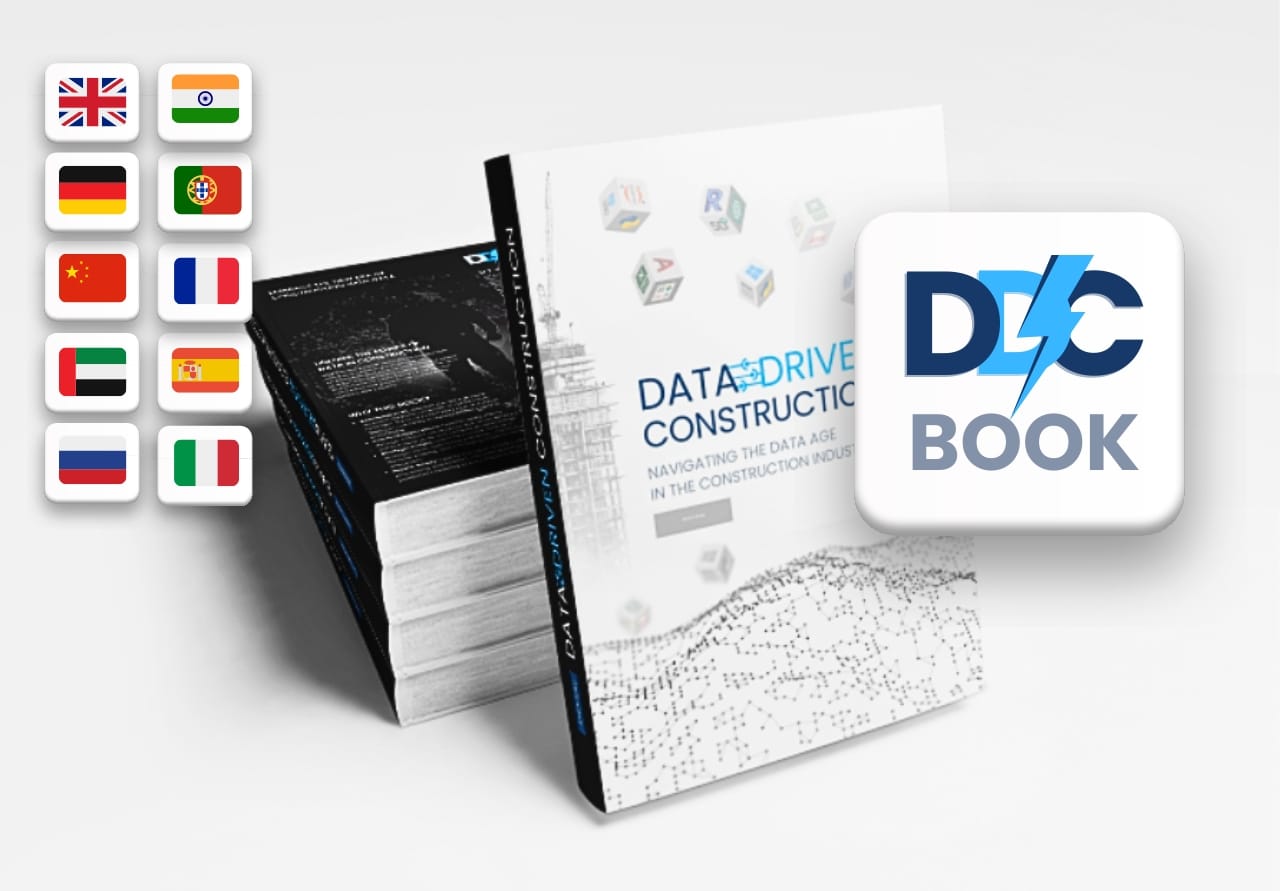
The majority of skills are based on the book “Data-Driven Construction” — a methodology for digital transformation in construction. The book explains the reasoning behind each skill category: why data silos matter, how to classify your data, and what to automate first.
|
Book structure maps to skills:
- Part I — Data landscape assessment →
2_DDC_Book/1.1-*, 1.2-*
- Part II — Data types and classification →
2_DDC_Book/2.1-* through 2.6-*
- Part III — Estimation and scheduling →
2_DDC_Book/3.1-* through 3.3-*
- Part IV — Analytics and ML →
2_DDC_Book/4.1-* through 4.5-*
- Part V — Threats and long-term strategy →
2_DDC_Book/5.*
Download Free in 31 Languages →
|
Resources
Support the Project
If you find these tools useful, please give the repository a star — it helps others discover these resources.

Related repositories:
Contributing
Contributions are welcome:
- Report issues — bugs, unclear documentation, broken links
- Suggest skills — describe the automation you need
- Submit PRs — new skills, improvements, translations
Each skill should include a SKILL.md with clear instructions and working code examples.
License
- CWICR Database: CC BY-NC 4.0 (non-commercial; separate DDC commercial license)
- DDC Tools: MIT License
- Skills: MIT License
Trademarks
All product names, logos, and brands mentioned in this repository are property of their respective owners. All company, product and service names used are for identification purposes only. Use of these names, logos, and brands does not imply endorsement.
- IFC is an open standard by buildingSMART International
- File format references (RVT, DWG, DGN, NWD, etc.) are used for technical interoperability purposes only
Start here → GETTING_STARTED.md


评论