📖 Explore the Full Documentation
Ready to dive deeper into TamaFi’s details? Discover the full story, in-depth tutorials, and all the exciting features in our comprehensive documentation. Click the link and explore further!
:star2: About the Project
TamaFi is a modern, WiFi-aware virtual pet.
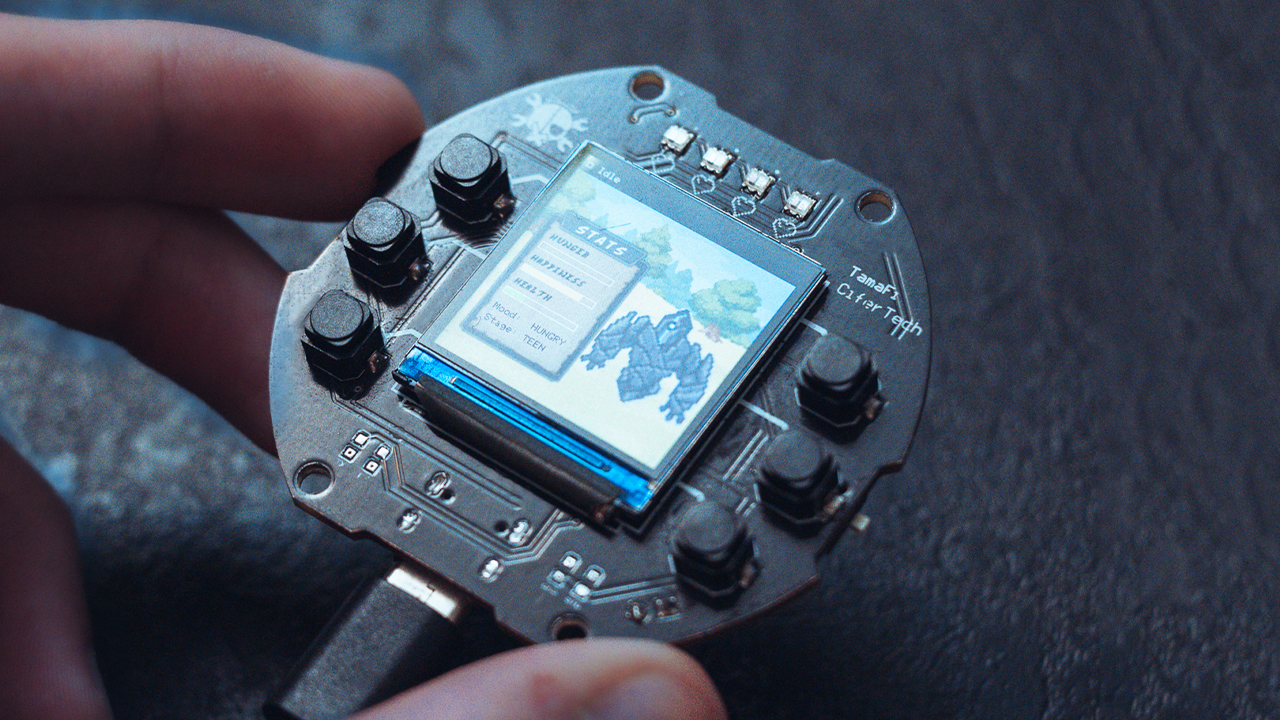
V2 rebuilds the original project with new hardware, smarter logic, and a clean, compact PCB that actually feels like a finished device.
The pet lives on an ESP32-S3, eats nearby WiFi, evolves over time, and makes its own decisions based on the environment around it.
✨ Highlights (V2)
- ⚙ ESP32-S3 based – more performance, native USB, better room for future features
- 🖥 TFT ST7789 240×240 – full-color UI, custom sprites, status bars, menus
- 🧠 Autonomous behavior engine – the pet hunts, explores, rests, and reacts on its own
- 📶 WiFi-fed – nearby networks affect hunger, happiness, and health
- 🎛 Full menu system – Pet Status, Environment, System Info, Controls, Settings, Diagnostics
- 💾 Persistent state – age, stats, stage, settings stored in flash (Preferences)
- 🌈 4× WS2812-2020 NeoPixels – mood & activity feedback (happy/sad/wifi/rest patterns)
- 🔊 Retro sound engine – non-blocking chiptune-style beeps and sequences
- 🔋 Battery-ready – TP4056 charger + MOSFET-controlled TFT backlight
- 🖱 6 soft tactile switches – three on each side for navigation and shortcuts
- 🛠 DisplayKit-ready UI workflow – UI graphics can be designed/exported via DisplayKit
⚠️ Some advanced / sensitive behaviors are intentionally simplified or left as placeholders in the public firmware.
This project is for learning, tinkering, and fun — not for breaking things.
🧩 How TamaFi V2 Behaves
TamaFi isn’t just a sprite animation loop. It runs a small decision engine that constantly evaluates:
- Pet stats:
hunger, happiness, health
- Traits: curiosity, activity, stress
- Environment: number of nearby networks, open/hidden networks, average RSSI
- Time: age (minutes → hours → days)
From that, it decides whether to:
- 🍖 Hunt – use WiFi scan results to “feed” and adjust hunger/happiness/health
- 👁 Explore – react to open/hidden networks and network diversity
- 😴 Rest – enter a sleep cycle with special egg animation and recovery stats
- 😐 Idle – chill on the home screen with mood-based idle animations
Mood system
The pet mood changes based on stats + environment:
HUNGRY – low hungerHAPPY – good stats + decent WiFiCURIOUS – hidden/open networks nearbyBORED – no WiFi for too longSICK – low health or bad conditionsEXCITED / CALM – good conditions & variety
Mood affects:
- Idle animation speed
- LED patterns
- How often it wants to hunt / explore / rest
Evolution
Age is tracked in minutes, hours, and days:
BABY → TEEN → ADULT → ELDER
Evolution depends on:
- Time alive
- Average of hunger / happiness / health
- Environment quality
Reaching a new stage triggers special SFX + animations.
All rendering goes through a 240×240 framebuffer (TFT_eSPI + TFT_eSprite) to avoid flicker.
Home Screen
- Pet sprite (idle / hunt / rest / special states)
- Background image
- Stats bars: Hunger, Happiness, Health
- Mood + Stage text
- Activity label in the top bar (
Idle, Hunting…, Resting…, etc.)
- Overlays for special effects (e.g. hunger effect)
Navigation is done using the left 3 buttons (UP / OK / DOWN).
Main Menu:
- Pet Status – stats, mood, age, stage, short description
- Environment – WiFi network counts, hidden/open, “signal mood”
- System Info – firmware version, uptime, battery (if implemented), etc.
- Controls – brightness, LED level, sound on/off, NeoPixel on/off
- Settings – auto-sleep, auto-save interval, soft reset options
- Diagnostics – debug info, test modes (non-destructive)
- Back to Home
Changes in Controls/Settings are saved to NVS via Preferences, so they persist across reboots.
🔌 Hardware Overview
This is a summary of the V2 hardware stack.
Check the PCB/ and Schematic/ directories for full details.
Core
- MCU: ESP32-S3 module
- Display: 1.3–1.54" TFT ST7789 @ 240×240
- Buttons: 6× soft tactile switches
- LEDs: 4× WS2812-2020 addressable RGB
- Buzzer: driven with PWM (LEDc) for retro SFX
Power
- Charger: TP4056 (single-cell Li-ion/Li-Po)
- Backlight control: MOSFET on TFT LED pin, driven by PWM for brightness levels
- Power input: USB-C (on PCB)
Connectivity / Dev
- ESP32-S3 native USB for firmware upload
- Optional CP2102 USB-to-TTL on the board for easier flashing / serial during development
🧰 Firmware
The firmware is written for Arduino IDE using:
TFT_eSPIAdafruit_NeoPixelWiFiPreferences
Core modules (conceptual)
main.ino – hardware init, timers, logic tick, button handlingui.cpp / ui.h – rendering, menus, bar drawing, layoutui_anim.h – sprite frame tables for idle, egg, hunt, etc.sound – non-blocking retro sound sequencer using LEDcstate – pet stats, traits, persistence with Preferences
The code is structured around non-blocking updates:
no delay() in the main logic, so animations, WiFi, sound, and UI can all coexist smoothly.
🧪 Status
V2 is still under active development. Expect rough edges.
| Area |
Status |
Notes |
| Core stats |
✅ Stable |
Hunger, happiness, health, age |
| Mood system |
✅ Stable |
Driven by stats + WiFi environment |
| Evolution |
✅ Stable |
Multi-stage, environment-aware |
| WiFi “feeding” |
✅ Stable |
Logic works; tuning values ongoing |
| Rest system |
✅ Stable |
Enter/exit animations + stat recovery |
| Hunt animation |
✅ Stable |
Uses dedicated attack frames |
| Menus & UI |
⚠ In progress |
Layout & styling still evolving |
| Sound engine |
✅ Stable |
Non-blocking retro SFX |
| NeoPixel effects |
⚠ In progress |
Mood + activity patterns, still tweaking |
| Desktop tooling |
⚠ Planned |
Companion webapp / deeper integration |
:warning: License
Distributed under the MIT License. See LICENSE.txt for more information.
▶ Support me on Patreon patreon.com/cifertech
CiferTech - @twitter - [email protected]
Project Link: https://github.com/cifertech/TamaFi
:gem: Acknowledgements
The libraries and projects listed below are used in this software:



评论