InsPLAD: Inspection of Power Line Assets Dataset
This repository stores InsPLAD, a dataset introduced in “InsPLAD: A Dataset and Benchmark for Power Line Asset Inspection in UAV Images” IJRS | arXiv. InsPLAD is also used in “Attention Modules Improve Image-Level Anomaly Detection for Industrial Inspection: A DifferNet Case Study” WACV2024 CVF | arXiv.
Abstract
Power line maintenance and inspection are essential to avoid power supply interruptions, reducing its high social and financial impacts yearly. Automating power line visual inspections remains a relevant open problem for the industry due to the lack of public real-world datasets of power line components and their various defects to foster new research. This paper introduces InsPLAD, a Power Line Asset Inspection Dataset and Benchmark containing 10,607 high-resolution Unmanned Aerial Vehicles colour images. The dataset contains seventeen unique power line assets captured from real-world operating power lines. Additionally, five of those assets present six defects: four of which are corrosion, one is a broken component, and one is a bird’s nest presence. All assets were labelled according to their condition, whether normal or the defect name found on an image level. We thoroughly evaluate state-of-the-art and popular methods for three image-level computer vision tasks covered by InsPLAD: object detection, through the AP metric; defect classification, through Balanced Accuracy; and anomaly detection, through the AUROC metric. InsPLAD offers various vision challenges from uncontrolled environments, such as multi-scale objects, multi-size class instances, multiple objects per image, intra-class variation, cluttered background, distinct point-of-views, perspective distortion, occlusion, and varied lighting conditions. To the best of our knowledge, InsPLAD is the first large real-world dataset and benchmark for power line asset inspection with multiple components and defects for various computer vision tasks, with a potential impact to improve state-of-the-art methods in the field. It will be publicly available in its integrity on a repository with a thorough description.
You can download the dataset here (Mendeley Data). Labels, when applicable, are in the zip files.
Three datasets in one. In the link above, you will find a single archive containing three zip files:
InsPLAD-det.zip is an Object Detection dataset for Asset detection- InsPLAD-fault folder:
supervised_fault_classification.zip is an Image Classification dataset for Fault Classification of the Assetsunsupervised_anomaly_detection.zip is an Unsupervised Anomaly Detection dataset also for Fault Classification of the Assets
>> Edit: Pixel-level annotations <<
We initiated pixel-level annotations here: https://universe.roboflow.com/andreluizbvs/insplad-seg
>> End of edit <<
Here is a straightforward workflow that can be applied when using InsPLAD:

The black boxes indicate the function of each sub-dataset in the Power line domain and which Computer Vision task (in parentheses) should be used for each sub-dataset.
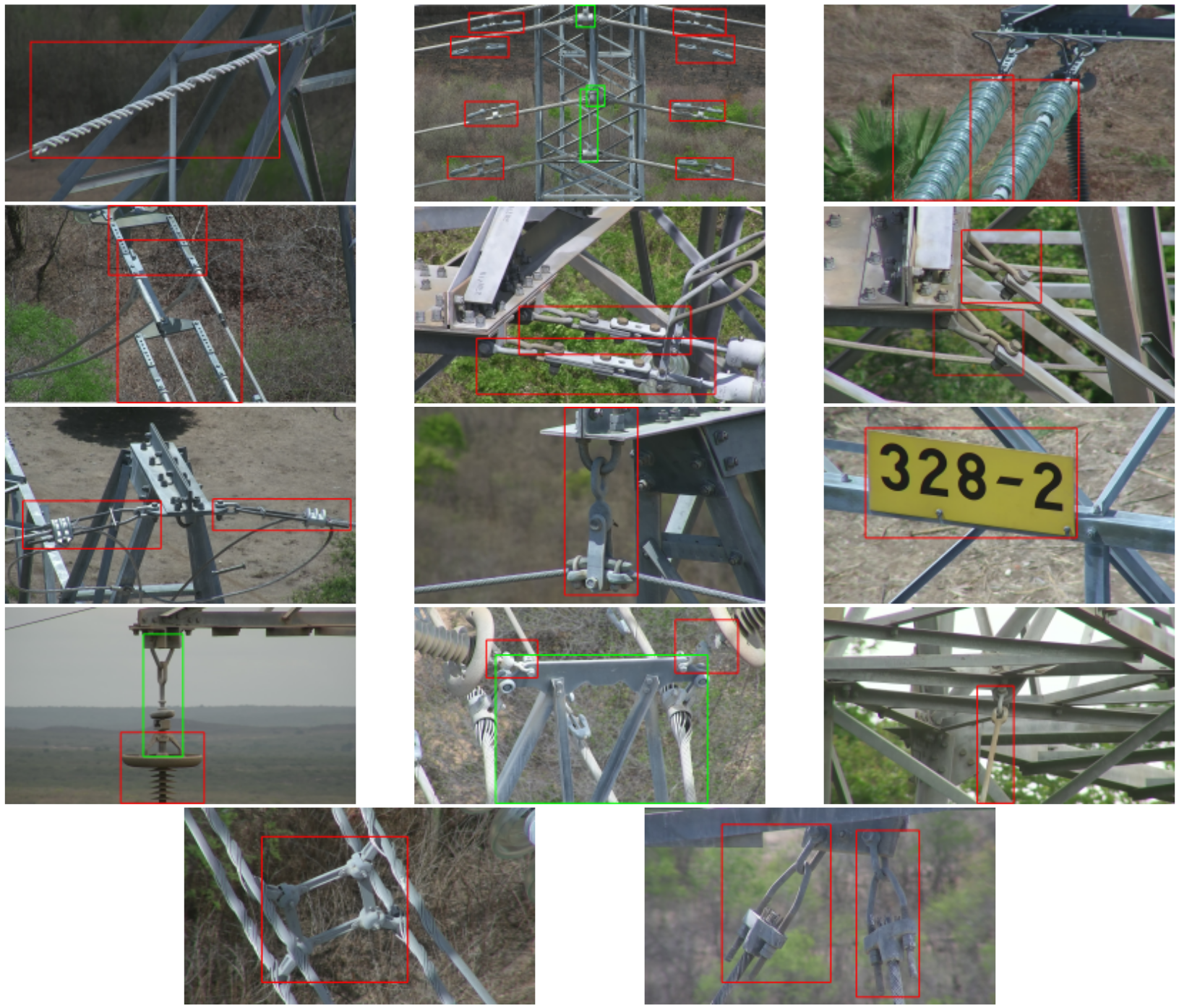
1. InsPLAD-det
Properties
- Object Detection dataset
- 17 classes (assets categories)
- 10,607 total images
- 28,933 total instances
- Other properties:

Samples
Different bounding box colors mean different classes (not normal/defective objects)
2. InsPLAD-fault
InsPLAD-fault is generated from InsPLAD-det. The annotated objects are cropped and classified into normal/defective.
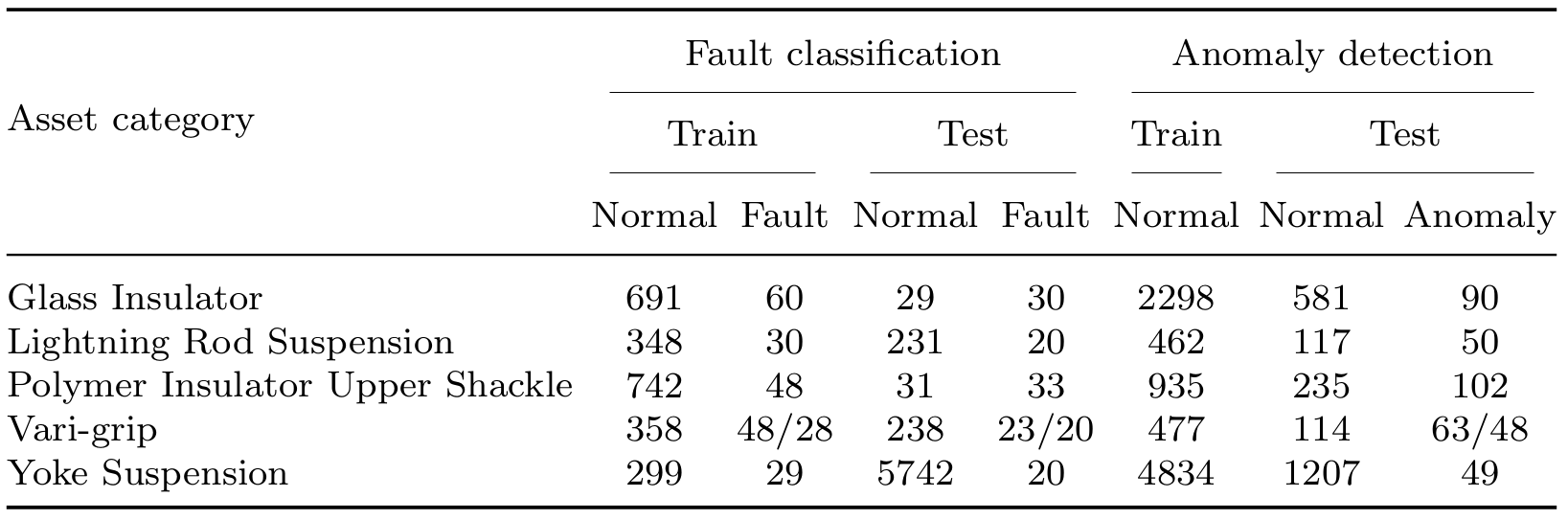
Properties
2.1 Supervised Fault Classification
- Image Classification dataset
- Five assets, 2 to 3 classes each (defect types, e.g., corrosion)
- Other properties in the table above
2.2 Unsupervised Anomaly Detection
- Anomaly Detection dataset
- Five assets, 2 classes each (normal or anomalous)
- Other properties in the table above
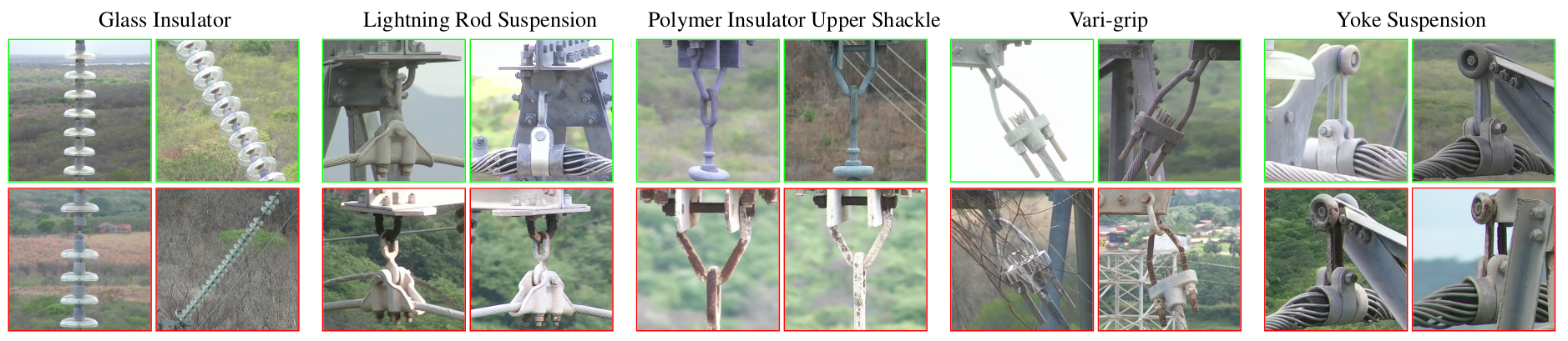
Samples
Normal on top (green frame), and defective at the bottom (red frame)
New project for segmentation
We started a new annotation project for Instance Segmentation (it will be the 4th CV task) here: https://universe.roboflow.com/andreluizbvs/insplad-seg
When it is finished we will update this repo.
Citing
If you use InsPLAD in your research, please cite it:
@article{doi:10.1080/01431161.2023.2283900,
   author    = {André Luiz Buarque Vieira e Silva, Heitor de Castro Felix, Franscisco Paulo Magalhães Simões, Veronica Teichrieb, Michel dos Santos, Hemir Santiago, Virginia Sgotti and Henrique Lott Neto},
   title     = {InsPLAD: A Dataset and Benchmark for Power Line Asset Inspection in UAV Images},
   journal   = {International Journal of Remote Sensing},
   volume    = {44},
   number    = {23},
   pages     = {1-27},
   year      = {2023},
   publisher = {Taylor & Francis},
   doi       = {10.1080/01431161.2023.2283900},
   URL       = {https://doi.org/10.1080/01431161.2023.2283900},
   eprint    = {https://doi.org/10.1080/01431161.2023.2283900},
}

@InProceedings{Vieira_2024_WACV,
    author    = {e Silva, Andr\'e Luiz Vieira and Sim\~oes, Francisco and Kowerko, Danny and Schlosser, Tobias and Battisti, Felipe and Teichrieb, Veronica},
    title     = {Attention Modules Improve Image-Level Anomaly Detection for Industrial Inspection: A DifferNet Case Study},
    booktitle = {Proceedings of the IEEE/CVF Winter Conference on Applications of Computer Vision (WACV)},
    month     = {January},
    year      = {2024},
    pages     = {8246-8255}
}


评论