DrivAerNet++: High-Fidelity Computational Fluid Dynamics & Deep Learning Benchmarks


The largest and most comprehensive multimodal dataset for aerodynamic car design
We present DrivAerNet++, comprising 8,150 diverse car designs modeled with high-fidelity computational fluid dynamics (CFD) simulations, covering configurations such as fastback, notchback, and estateback.
📢 Latest News
| Date |
News |
| 🆕 2026 |
CarCrashNet Released — A large-scale, high-fidelity crash simulation dataset and benchmark for learning vehicle crash dynamics |
| 🆕 2026 |
CarBench Released — A unified benchmark for high-fidelity 3D car aerodynamics and generalization testing |
🏎️ Design & Shape Variation
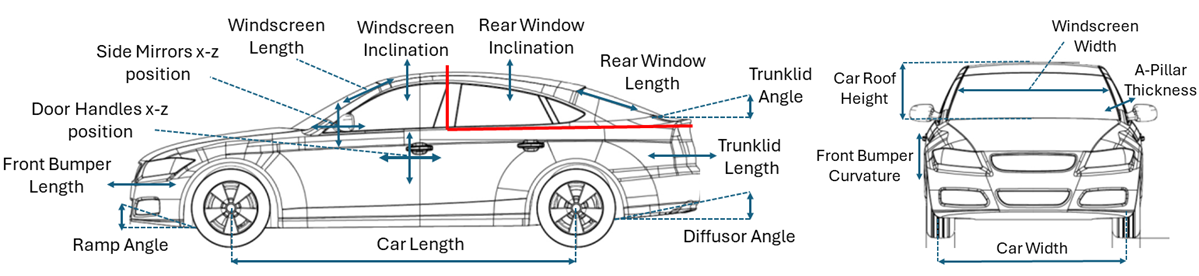
Design Parameters
Several geometric parameters with significant impact on aerodynamics were selected and varied within a specific range. These parameter ranges were chosen to avoid values that are either difficult to manufacture or not aesthetically pleasing.
Shape Variation
DrivAerNet++ covers all conventional car designs. The dataset encompasses various underbody and wheel designs to represent both:
- Internal Combustion Engine (ICE) vehicles
- Electric Vehicles (EV)
💡 Each 3D car geometry is parametrized with 26 parameters that completely describe the design.

Importance of Diversity
By providing a wide range of car shapes and configurations with high-fidelity CFD, DrivAerNet++ enables:
- ✅ Models to generalize better
- ✅ Exploration of unconventional designs
- ✅ Enhanced understanding of how geometric features impact aerodynamic performance

📦 Dataset Contents & Modalities
✅ Available Modalities
| Modality |
Description |
| Parametric Models |
Structured tabular design parameters |
| Volumetric Fields |
Full 3D CFD (pressure, velocity, turbulence) |
| Surface Fields |
Coefficient of pressure (Cp) and Wall Shear Stress (WSS) |
| Streamlines |
Flow visualization data illustrating streamlines |
| Point Clouds |
Dense and sparse point cloud representations |
| Meshes |
High-resolution 3D surface triangulations |
| Aerodynamic Coefficients |
Drag (Cd), Lift (Cl), and moment coefficients |
| Annotations |
Per-part semantic labels |
| Renderings |
High-quality photorealistic 2D renderings |
| Sketches |
Hand-drawn style sketches (Canny edge & CLIPasso) |
🚧 Coming Soon
- 📐 2D Slices: Planar field extractions
- 📊 Signed Distance Fields (SDF): For occupancy modeling
- 💥 Deformations: Simulation outputs under crash/pressure conditions
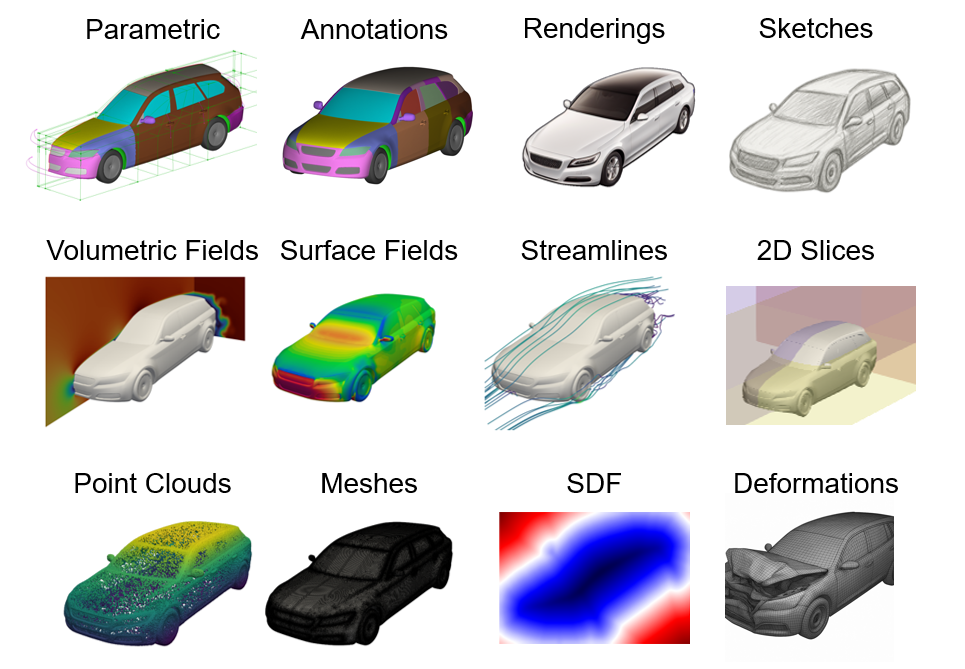
Dataset Annotations
The dataset includes detailed annotations for various car components (29 labels), such as wheels, side mirrors, and doors. These are instrumental for:
- Classification
- Semantic segmentation
- Automated meshing
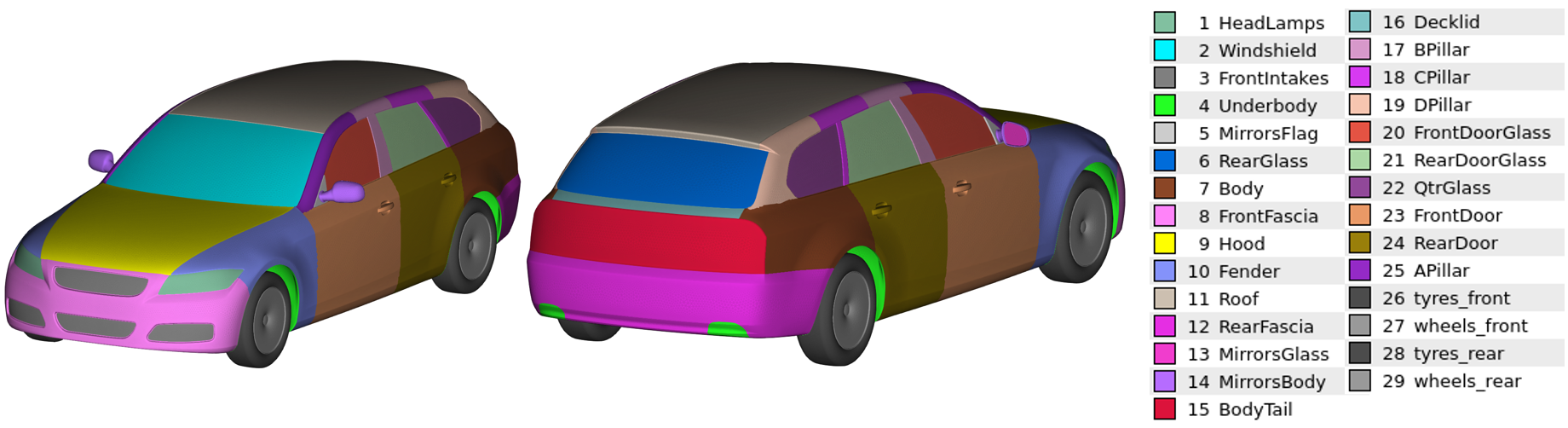
✏️ Sketch-to-Design Extension
We bridge the gap between conceptual creativity and computational design with 2D hand-drawn sketches and photorealistic renderings.
🔍 For details, check out our recent Design Agents paper: AI Agents in Engineering Design
💾 Dataset Access & Download
The dataset is hosted on Harvard Dataverse (CC BY-NC 4.0).
| Specification |
Value |
| Total Size |
39 TB |
| Subsets |
3D Meshes, Pressure, Wall Shear Stress, Full CFD Domain |
We provide instructions on how to use Globus to download the dataset efficiently.
Datasets Comparison
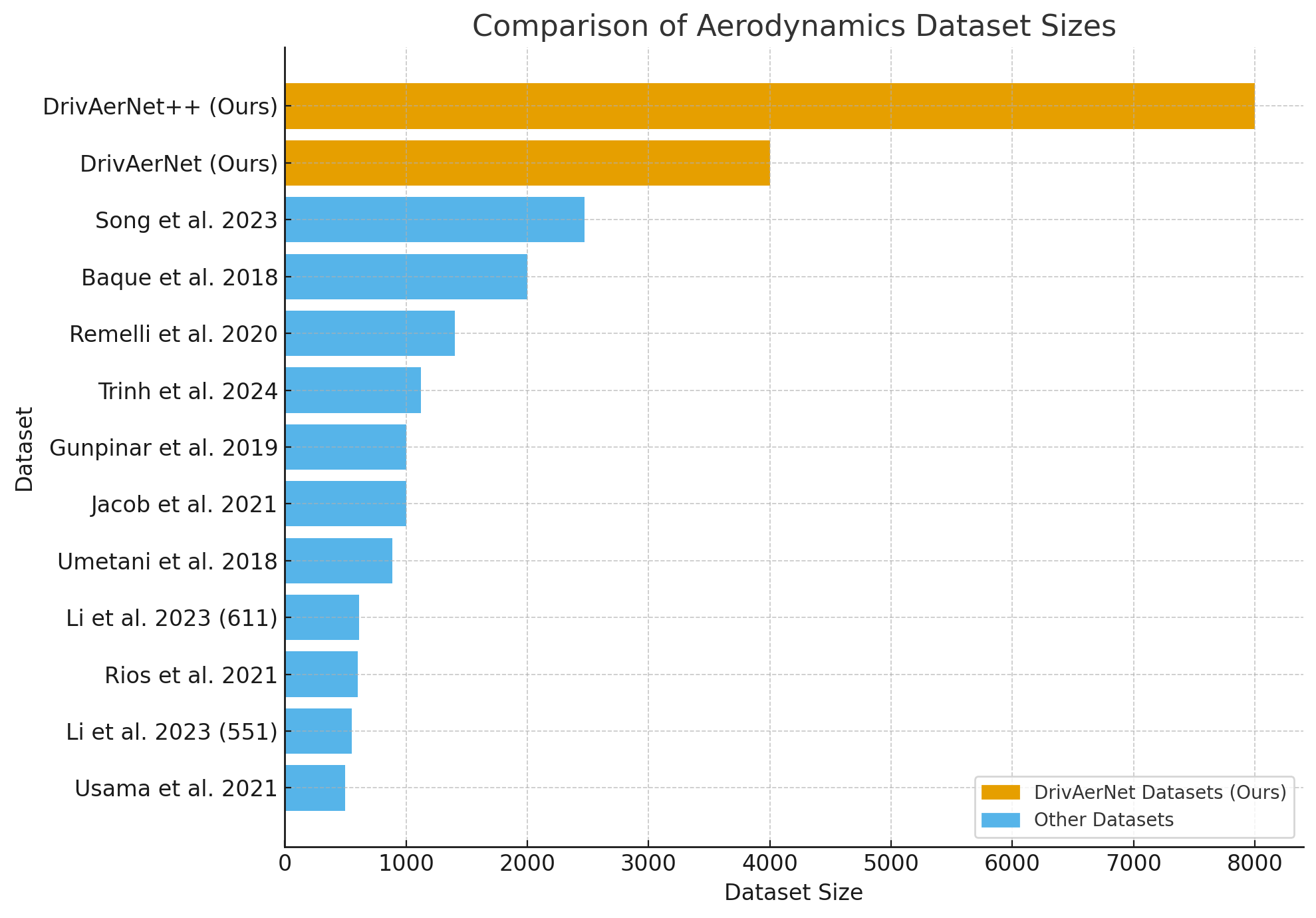
DrivAerNet++ stands out as the largest and most comprehensive dataset in the field.
🏆 Leaderboard & Comparisons
DrivAerNet++ serves as a valuable benchmark dataset due to its size and diversity. It provides extensive coverage of various car designs and configurations, making it ideal for testing and validating machine learning models in aerodynamic design. We provide the train, test, and validation splits in the following folder: train_val_test_splits.
Drag values for the 8k car designs can be found Here, and the frontal projected areas Here.
Researchers and industry practitioners can submit their models to the leaderboard to compare performance against state-of-the-art baselines. The benchmark promotes transparency, reproducibility, and innovation in AI-driven aerodynamic modeling.
For submission guidelines and current rankings, visit CarBench.
📄 Read CarBench Paper
TripOptimizer
A fully differentiable deep-learning framework for rapid aerodynamic analysis and shape optimization on industry-standard car designs.
📄 Read Paper
AI Agents in Engineering Design
A multi-agent framework leveraging VLMs and LLMs to accelerate the car design process—from concept sketching to CAD modeling, meshing, and simulation.
📄 Read Paper
RegDGCNN
We have open-sourced the RegDGCNN pipeline for surface field prediction on 3D car meshes.
🛠️ Framework Integrations
DrivAerNet++ is integrated into leading Scientific Machine Learning (SciML) frameworks:
NVIDIA Modulus
PaddleScience (Baidu)
🔗 IJCAI 2024 Competition
🔗 PaddleScience DrivAerNet Example
🔗 PaddleScience DrivAerNet++ Example
💻 Computational Cost & Applications
Resources Used
| Resource |
Specification |
| Infrastructure |
MIT Supercloud (60 nodes, 2880 CPU cores) |
| Cost |
Approx. 3 × 10⁶ CPU-hours |
Applications
DrivAerNet++ supports a wide array of machine learning applications, including but not limited to:
- 🚀 Data-driven design optimization: Optimize car designs based on aerodynamic performance.
- 🧠 Generative AI: Train generative models to create new car designs based on performance or aesthetics.
- 🎯 Surrogate models: Predict aerodynamic performance without full CFD simulations.
- 🔥 CFD simulation acceleration: Speed up simulations using machine learning and multi-GPU techniques.
- 📉 Reduced Order Modeling: Create data-driven reduced-order models for efficient & fast aerodynamic simulations.
- 💾 Large-Scale Data Handling: Efficiently store and manage large datasets from high-fidelity simulations.
- 🗜️ Data Compression: Implement high-performance lossless compression techniques.
- 🌐 Part and shape classification: Classify car categories or components to enhance design analysis.
- 🔧 Automated CFD meshing: Automate the meshing process based on car components to streamline simulations.
⚖️ License & Commercial Use
Strict Licensing Notice
⚠️ DrivAerNet/DrivAerNet++ is released under the Creative Commons Attribution-NonCommercial 4.0 International License (CC BY-NC 4.0).
| Usage |
Status |
| ✅ Non-commercial research |
Allowed |
| ✅ Educational purposes |
Allowed |
| ❌ Commercial use |
Prohibited |
| ❌ Model training for commercial tools |
Prohibited |
| ❌ Commercial R&D |
Prohibited |
Code License: MIT License
Commercial Inquiry
For commercial licensing, please contact:
📧 Mohamed Elrefaie — [email protected]
📧 Faez Ahmed — [email protected]
Subject: "DrivAerNet Commercial Inquiry"
📖 Citations
DrivAerNet++ (NeurIPS 2024)
@inproceedings{NEURIPS2024_013cf29a,
    author    = {Elrefaie, Mohamed and Morar, Florin and Dai, Angela and Ahmed, Faez},
    booktitle = {Advances in Neural Information Processing Systems},
    editor    = {A. Globerson and L. Mackey and D. Belgrave and A. Fan and U. Paquet and J. Tomczak and C. Zhang},
    pages     = {499--536},
    publisher = {Curran Associates, Inc.},
    title     = {DrivAerNet++: A Large-Scale Multimodal Car Dataset with Computational Fluid Dynamics Simulations and Deep Learning Benchmarks},
    url       = {https://proceedings.neurips.cc/paper_files/paper/2024/file/013cf29a9e68e4411d0593040a8a1eb3-Paper-Datasets_and_Benchmarks_Track.pdf},
    volume    = {37},
    year      = {2024}
}
Journal of Mechanical Design
@article{elrefaie2025drivaernet,
    title     = {DrivAerNet: A Parametric Car Dataset for Data-Driven Aerodynamic Design and Prediction},
    author    = {Elrefaie, Mohamed and Dai, Angela and Ahmed, Faez},
    journal   = {Journal of Mechanical Design},
    volume    = {147},
    number    = {4},
    year      = {2025},
    publisher = {American Society of Mechanical Engineers Digital Collection}
}
IDETC-CIE 2024
@proceedings{10.1115/DETC2024-143593,
    author = {Elrefaie, Mohamed and Dai, Angela and Ahmed, Faez},
    title  = {DrivAerNet: A Parametric Car Dataset for Data-Driven Aerodynamic Design and Graph-Based Drag Prediction},
    volume = {Volume 3A: 50th Design Automation Conference (DAC)},
    series = {International Design Engineering Technical Conferences and Computers and Information in Engineering Conference},
    pages  = {V03AT03A019},
    year   = {2024},
    month  = {08},
    doi    = {10.1115/DETC2024-143593},
    url    = {https://doi.org/10.1115/DETC2024-143593}
}
🔧 Maintenance & Support
Maintained by the DeCoDE Lab at MIT


评论