What it does
Give it SQL. Get an AST you can walk, rewrite, and print back out.
SELECT 1 FROM dual WHERE a = b
SQL Text
 └─Statements: statement.select.PlainSelect
    ├─selectItems: statement.select.SelectItem
    │  └─LongValue: 1
    ├─Table: dual
    └─where: expression.operators.relational.EqualsTo
       ├─Column: a
       └─Column: b
String sqlStr = "select 1 from dual where a=b";

PlainSelect select = (PlainSelect) CCJSqlParserUtil.parse(sqlStr);

SelectItem selectItem = select.getSelectItems().get(0);
Assertions.assertEquals(new LongValue(1), selectItem.getExpression());

Table table = (Table) select.getFromItem();
Assertions.assertEquals("dual", table.getName());

EqualsTo equalsTo = (EqualsTo) select.getWhere();
Column a = (Column) equalsTo.getLeftExpression();
Column b = (Column) equalsTo.getRightExpression();
Assertions.assertEquals("a", a.getColumnName());
        Assertions.assertEquals("b", b.getColumnName());
The tree is traversable with the Visitor pattern, and the same object model works in reverse:
build statements from Java with a fluent API
and render them as SQL text.
Install
Use the stable Manticore builds. They are released continuously from the current development
line and carry all of the performance and grammar work described below. The upstream
com.github.jsqlparser release on Maven Central is considerably older.
<dependency>
    <groupId>com.manticore-projects.jsqlformatter</groupId>
    <artifactId>jsqlparser</artifactId>
    <version>[5.3.218,)</version>
</dependency>
implementation("com.manticore-projects.jsqlformatter:jsqlparser:+")
Upstream release and snapshots
<dependency>
    <groupId>com.github.jsqlparser</groupId>
    <artifactId>jsqlparser</artifactId>
    <version>5.3</version>
</dependency>
Snapshot coordinates and repository setup are on the
build dependencies page.
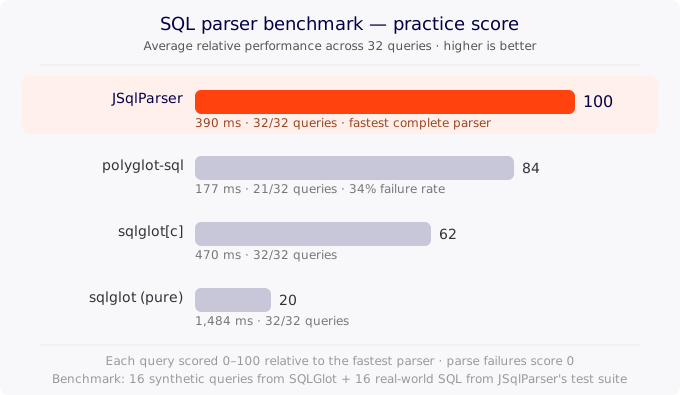
11× faster than 5.3, and the fastest parser on real-world SQL of any of the parsers
tested, in any language — 19× ahead of sqlglot[c] on JSqlParser’s own SELECT test suite. And the community kept sending performance improvements since. Thank you everyone!
Benchmark                                     (version)  Mode  Cnt    Score   Error  Units
JSQLParserBenchmark.parseSQLStatements           latest  avgt   15   21.138 ± 0.557  ms/op <-- Community sponsored improvements!
JSQLParserBenchmark.parseSQLStatements              5.4  avgt   15   32.528 ± 0.666  ms/op
JSQLParserBenchmark.parseSQLStatements              5.3  avgt   15  983.459 ± 8.197  ms/op
JSQLParserBenchmark.parseSQLStatements              5.1  avgt   15  319.601 ± 4.081  ms/op
Methodology and the full cross-parser comparison against SQLGlot, sqlglot[c] and
polyglot-sql: jsqlparser-bench.
What it parses
JSqlParser targets the SQL standard plus all major RDBMS. One grammar covers all of them,
and missing syntax gets added on demand — open an issue.
BigQuery · Snowflake · DuckDB · Redshift · Oracle · MS SQL Server · Sybase
PostgreSQL · MySQL · MariaDB · DB2 · H2 · HSQLDB · Derby · SQLite
|
Statements |
| Queries |
SELECT · WITH … · Piped SQL |
| ksqlDB windows |
JOIN WITHIN, window GRACE PERIOD, and EMIT CHANGES/FINAL |
| ClickHouse column selection |
COLUMNS('regexp') select items with chained APPLY, EXCEPT, and REPLACE transformers |
| DML |
INSERT · UPDATE · UPSERT · MERGE · DELETE · TRUNCATE TABLE |
| Oracle RETURNING |
Named output binds (INTO :name), JDBC output parameters (INTO ?), and BULK COLLECT INTO |
| DDL |
CREATE … · ALTER … · DROP … |
| Oracle vector types |
VECTOR(*, *) · VECTOR(*, FLOAT32) · VECTOR(3, *), including dense and sparse storage formats |
| PostgreSQL ownership |
DROP OWNED · REASSIGN OWNED |
| MySQL table maintenance |
ANALYZE · CHECK · CHECKSUM · OPTIMIZE · REPAIR TABLE |
| PostgreSQL maintenance |
VACUUM · ANALYZE · CLUSTER · CHECKPOINT |
| MySQL locks |
LOCK TABLES · UNLOCK TABLES · LOCK INSTANCE FOR BACKUP · UNLOCK INSTANCE |
| MySQL account management |
CREATE/ALTER/RENAME USER · CREATE ROLE · SET ROLE · SET DEFAULT ROLE · SET PASSWORD |
| Tablespaces |
MySQL and PostgreSQL CREATE TABLESPACE · ALTER TABLESPACE |
| PostgreSQL RLS |
CREATE POLICY · ALTER TABLE … ENABLE/DISABLE/FORCE/NO FORCE ROW LEVEL SECURITY |
| Routine changes |
ALTER FUNCTION · ALTER PROCEDURE · ALTER ROUTINE · PostgreSQL ALTER TRIGGER |
| MySQL metadata statements |
SHOW [FULL] COLUMNS/FIELDS · SHOW TABLE STATUS · SHOW CREATE TABLE/VIEW/PROCEDURE/FUNCTION/TRIGGER/EVENT/DATABASE/USER |
| PostgreSQL administration |
CREATE/ALTER EVENT TRIGGER · REINDEX · SECURITY LABEL |
| Informix constraints |
ALTER TABLE … ADD CONSTRAINT with trailing constraint names for primary, unique, foreign and check constraints; enable with parser.withDialect(Dialect.INFORMIX) |
| Salesforce SOQL |
INCLUDES · EXCLUDES |
Beyond statement shapes, the grammar handles nested sub-selects, bind parameters (?,
:name), window and analytic functions, Oracle hints, and the T-SQL square-bracket versus
array-literal ambiguity. The complete reference is on the
syntax page.
PostgreSQL dollar-quoted strings, including $tag$…$tag$, retain their delimiter and
literal body in StringValue. Tagged quotes are disabled by default to preserve
identifier parsing. Enable them with parser.withDialect(Dialect.POSTGRESQL) or
parser.withDollarQuotedStringTags(true). Untagged $$…$$ literals remain enabled.
Statement classification
Any parsed statement can say what it actually does — no second parse, no visitor to write:
StatementFeatures features = CCJSqlParserUtil.parse(sqlStr).getFeatures();

// safeguard a read-only client before anything reaches the database
if (connection.isReadOnly() && features.mayModifyData()) {
    throw new SQLException("rejected: " + features.getUnresolvedReferences());
}

// dispatch correctly
if (features.returnsResultSet()) { statement.executeQuery(sqlStr);  }
else                             { statement.executeUpdate(sqlStr); }
This is not sqlStr.startsWith("SELECT") with extra steps. RETURNING turns DML into a row
source, a data-modifying CTE hides a DELETE inside a SELECT, and INSERT INTO x SELECT ..
contains a query but returns nothing:
| SQL |
returns rows |
modifies data |
SELECT * FROM t |
yes |
no |
INSERT INTO x SELECT * FROM t |
no |
yes |
DELETE FROM t RETURNING * |
yes |
yes |
WITH c AS (DELETE FROM t RETURNING *) SELECT * FROM c |
yes |
yes |
SELECT nextval('s') |
yes |
unproven |
Features are not mutually exclusive, and each is three-valued: proven, not excludable, or ruled
out. is() answers “did the grammar prove it”, may() answers “could it be ruled out” — so a
guard uses may() and a dispatcher uses is(). Function volatility is not a syntactic property,
so anything the caller has not declared pure stays unproven and is listed by name.
Legacy MySQL GROUP BY ... ASC/DESC is available with Dialect.MYSQL and the explicit
withLegacyMySqlGroupBy(true) option; modern/default parsing keeps it disabled.
Piped SQL
Support is progressing for Piped SQL, which writes queries in the order they actually
execute rather than the order SQL historically demanded.
FROM Produce
|> WHERE
    item != 'bananas'
    AND category IN ('fruit', 'nut')
|> AGGREGATE COUNT(*) AS num_items, SUM(sales) AS total_sales
   GROUP BY item
|> ORDER BY item DESC;
Background reading: the Google research paper,
BigQuery pipe syntax
and DuckDB FROM-first syntax.
ODBC {fn TIMESTAMPADD(...)} and {fn TIMESTAMPDIFF(...)} expose standard
SQL_TSI_* interval arguments as time-unit expressions, preserving column traversal.
Java version
| JSqlParser |
Runtime |
Notes |
| 4.9 |
JDK 8 |
last JDK 8 compatible release |
| 5.0 and later |
JDK 11 |
breaking changes to the AST Visitors, see the Migration Guide |
| 5.1 and later |
JDK 11 |
building requires a JDK 17 toolchain (plugin requirement) |
| 5.4 and later |
JDK 11 |
parser generated with JavaCC 8 |
Sister projects
Alternatives
The dual-licensed JOOQ
ships a hand-written parser with broad RDBMS support, cross-dialect translation, SQL
transformation, and a JDBC proxy mode. Worth a look if translation between dialects is your
primary need rather than AST access.
A huge thank you to Starlake.ai, who simplify data ingestion,
transformation and orchestration for faster delivery of high-quality data. Starlake has been
instrumental in providing Piped SQL support and a large number of test cases for BigQuery,
Redshift, Databricks and DuckDB. If JSqlParser is useful to you, visit
Starlake.ai and give them a star.
Documentation
- Samples
- Build instructions and Maven artifact
- Contribution guide
- Change log
- Issues
License
Dual licensed under LGPL 2.1 or the Apache License, Version 2.0. Take your pick.





评论