Bgolearn
A unified Bayesian optimization framework for accelerating materials discovery.


Language:
English |
简体中文 |
日本語 |
한국어 |
Deutsch
Playground:
Interactive Bayesian optimization game
Our work was featured on Dragon TV (东方卫视), highlighting its research and applications.
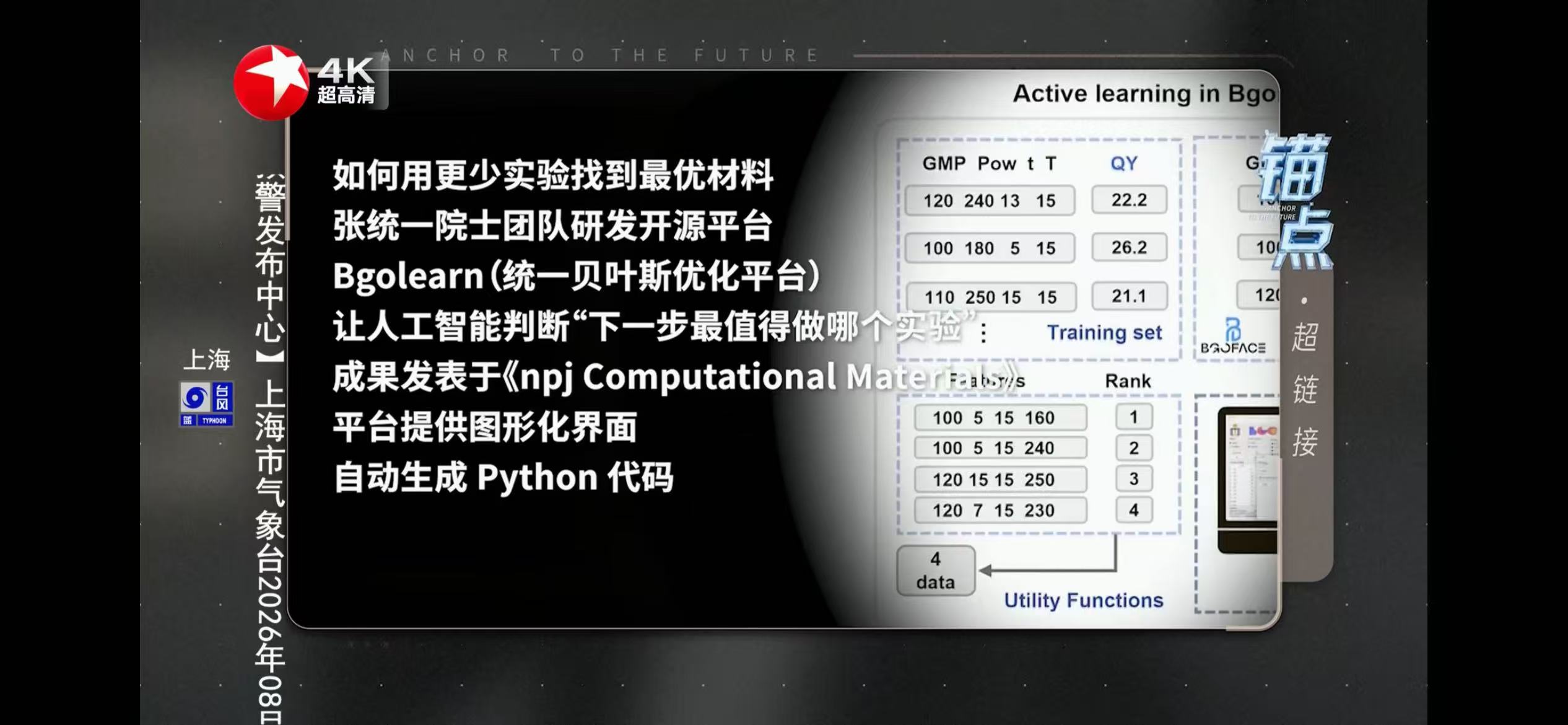
Featured on Dragon TV (东方卫视), Shanghai Media Group (SMG).
Featured Introduction
Bayesian Global Optimization is Chapter 1 of the Springer book An Introduction to Materials Informatics by Prof. Tong-Yi Zhang, Academician of the Chinese Academy of Sciences. The active-learning examples and results in this chapter are implemented with and depend on Bgolearn.
Overview
Bgolearn is a research-oriented Python framework for Bayesian Global Optimization (BGO). It is designed for data-driven materials discovery, experimental design, and virtual screening, where each new measurement can be costly and every recommendation should be traceable.
The framework brings surrogate modeling, uncertainty-aware acquisition, active learning, and candidate ranking into a single workflow. It supports both regression and classification tasks, so researchers can move from small experimental datasets to the next most informative material candidates with less custom glue code.
Highlights
- Unified workflows for regression, classification, active learning, and virtual screening.
- Multiple surrogate models, including Gaussian process, SVM, random forest, AdaBoost, and MLP-based options.
- Acquisition functions for noisy and noise-free optimization, including EI, AEI, EQI, REI, UCB, PoI, PES, and KG.
- Candidate recommendation for minimization, maximization, and multi-objective research workflows.
- A lightweight local web interface for users who prefer an interactive workflow.
Resources
Representative Applications
Bgolearn has supported a growing set of materials science and engineering studies. The following papers are a representative subset:
2026
2025
2024
Installation
Install from PyPI:
pip install Bgolearn
Upgrade to the latest release:
pip install --upgrade Bgolearn
Check the installed version:
pip show Bgolearn
Run the Interface
Clone the repository and start the local UI:
git clone https://github.com/Bin-Cao/Bgolearn.git
cd Bgolearn
python bgolearn_ui.py
Then open:
http://127.0.0.1:8787
Citation
If Bgolearn supports your research, please cite:
@article{Cao2026Bgolearn,
  author    = {Bin Cao and Jie Xiong and Jiaxuan Ma and Yuan Tian and Yirui Hu and Mengwei He and Longhan Zhang and Jiayu Wang and Jian Hui and Li Liu and Dezhen Xue and Turab Lookman and Jun Wang and Tong-Yi Zhang},
  title     = {Bgolearn: a unified Bayesian optimization framework for accelerating materials discovery},
  journal   = {npj Computational Materials},
  year      = {2026},
  doi       = {10.1038/s41524-026-02226-3},
  issn      = {2057-3960},
  publisher = {Springer Nature},
  url       = {https://doi.org/10.1038/s41524-026-02226-3}
}
Funding
Bgolearn was selected for the Open-Source Artificial Intelligence Support Program (2025) supported by the Shanghai Municipal Commission of Economy and Informatization.
Project material: figures/funding.png
License
Bgolearn is released under the MIT License.


评论